

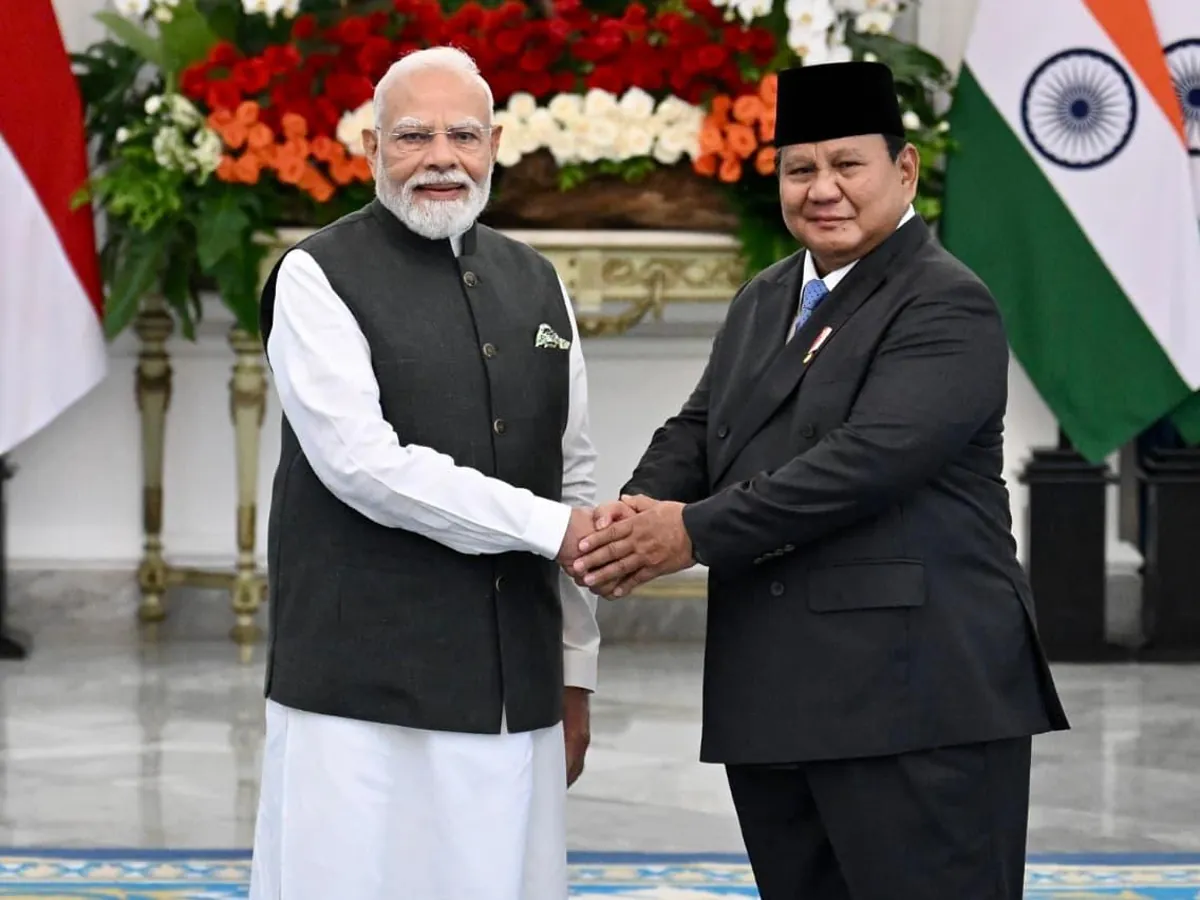
President Prabowo Subianto and Indian Prime Minister Narendra Modi witnessed the signing of 16 cooperation agreements at Istana Merdeka in Jakarta on Tuesday, covering the acquisition of India's Astra air-to-air missiles, space cooperation, agriculture, pharmaceuticals, and education. The two countries set a bilateral trade target of US$100 billion by 2030, double the goal set during Modi's 2018 visit to Indonesia, which remains less than half-fulfilled.
The document count varies by source: the Presidential Secretariat counted 16, while Indian media reported up to 20 memoranda of understanding. The difference arises because some documents are inter-agency or inter-company MoUs, separate from government-to-government agreements.
Why the $100 billion target needs scrutiny?
The target requires a fourfold increase in trade value from current levels within four years. When Modi visited Indonesia in 2018, both countries set a US$50 billion bilateral trade goal for 2025. Actual trade reached about US$24.78 billion in fiscal year 2025-26, according to available figures, less than half the pledge.
The gap traces to trade structure. India runs a deficit of roughly US$20 billion with Indonesia, buying coal, crude palm oil, and minerals. That commodity pattern took decades to form and changes slowly without concrete downstream investment. Indonesia holds about 21 percent of the world's nickel reserves, a commodity India now wants for its electric vehicle battery supply chain. Whether the seven sectors agreed upon Tuesday drive manufacturing investment and technology transfer, or simply expand raw commodity exports, will become clear from document details not yet published.
Defense package and strategic connectivity
The defense portion of the visit includes the acquisition of India's Astra air-to-air missiles and the signing of a BrahMos supersonic cruise missile contract, both formally concluded during this visit. India is also assisting with the development of electronic voting machines.
The two countries agreed on a port connectivity corridor: Indonesia will develop Sabang Port at the western tip of Aceh province, while India develops ports in the Andaman and Nicobar Islands. The two points flank the mouth of the Strait of Malacca, the world's busiest shipping lane. India frames the package within its Act East Policy and MAHASAGAR vision for a free and open Indo-Pacific.
From affordable medicines to an IIM campus
Modi said the pharmaceutical cooperation will expand access to affordable Indian medicines. "Through the agreements signed today, quality and affordable medicines from India will be increasingly available to Indonesian citizens," he said.
On education, both leaders backed the establishment of an Indian Institute of Management (IIM) campus in Indonesia, with an Indian Institute of Technology (IIT) campus as a possible follow-up. "In the field of education, both Prime Minister Modi and I support the establishment of an Indian Institute of Management campus and also the possibility of establishing an Indian Institute of Technology in Indonesia," Prabowo said. IIM and IIT are India's premier institutions for management and engineering talent.
One MoU covers the restoration of Prambanan temple with Indian assistance. The years 2026-2027 have been designated the "Tagore-Dewantara Year," marking the two countries' cultural and intellectual ties.
A fourth visit, an unfinished record
Modi arrived at Halim Perdanakusuma Air Force Base on Monday afternoon (July 6) and is scheduled to visit Prambanan in Yogyakarta before departing for Australia. This is his fourth visit to Indonesia and his second full state visit after 2018. Prabowo was a guest of honor at India's Republic Day in January 2025. Indonesia and India have maintained diplomatic relations since 1951, a bond reinforced at the Asia-Africa Conference in Bandung in 1955.
"Prime Minister Modi's visit this time is a historic milestone," Prabowo said. "This visit is a mirror of both countries' commitment to continue advancing the comprehensive strategic partnership through concrete and mutually beneficial cooperation."
Three things will determine the real weight of this visit: the official text of the 16 documents and their binding status, the manufacturing investment schemes in nickel and the digital economy, and funding certainty and a timeline for the Sabang project. None has been announced.

Comments