

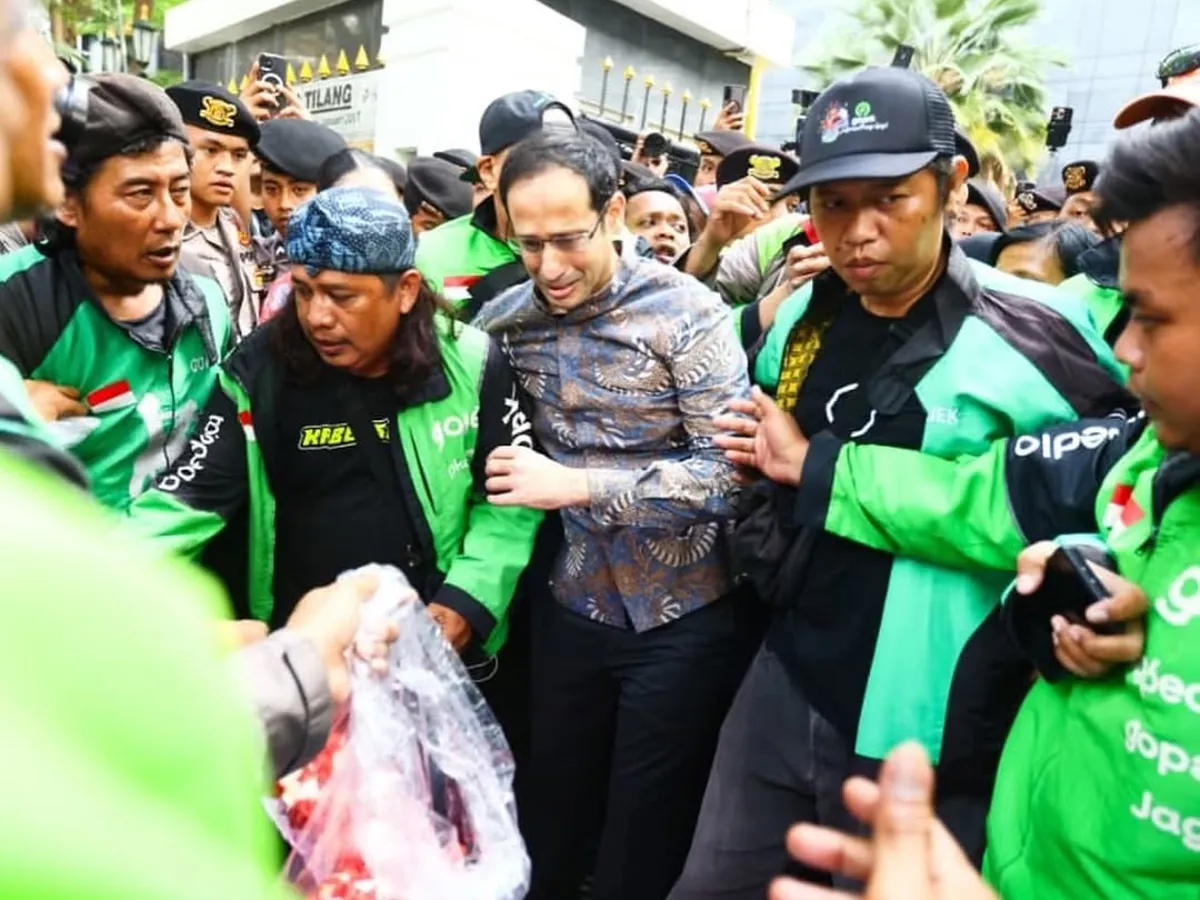
Nadiem Anwar Makarim's legal team filed an ethics complaint Monday with Indonesia's Judicial Commission (KY) against the four judges who convicted the former education minister: presiding judge Purwanto S Abdullah and three panel members, Eryusman, Sunoto, and Mardiantos. The fifth member of the five-judge panel, Andi Saputra, who dissented and argued for acquittal, was not named in the complaint.
The complaint was submitted at the KY building in Central Jakarta by lead counsel Ari Yusuf Amir; Nadiem's wife was also present. Ari said the team's objections concerned how the panel handled facts in its deliberations, distinct from the guilty verdict itself, which he acknowledged as legally valid.
"We are reporting the four judges who ruled Nadiem guilty. For us, the guilty verdict is valid... But the manipulation of trial facts, that is what we regret," Ari said.
He elaborated: "There are many facts that should have been included in the deliberation process but were not presented, or conversely, facts that were never there but appeared in the ruling."
The team also accused two of the four judges, Eryusman and Mardiantos, of falling asleep during hearings, and said it had video evidence.
Why is Purwanto at the center of this complaint?
Purwanto S Abdullah, the presiding judge in Nadiem's trial, was already under KY scrutiny before the case began. On December 8, 2025, the KY issued Decision No. 0098/L/KY/VIII/2025 in plenary session, recommending a six-month suspension for Purwanto and two other judges in connection with a sugar import corruption case involving defendant Tom Lembong.
A KY recommendation is a proposal to the Supreme Court, not a binding sanction. Despite this, the Supreme Court assigned Purwanto as presiding judge in Nadiem's case, which ran for months after that recommendation was issued.
"The presiding judge, Purwanto, who had already been handed a suspension recommendation by the Judicial Commission in the Tom Lembong case, was then assigned again as presiding judge in Nadiem Anwar Makarim's case," Ari said.
That gap between the KY recommendation and the Supreme Court's assignment is now one of the core arguments the legal team is using to challenge the panel's composition. One question remains publicly unanswered: on what basis did the Supreme Court assign Purwanto to this high-profile case while the sanction process from the earlier case had not yet been carried out?
10-year sentence and appeals from both sides
On June 30, 2026, the panel sentenced Nadiem to 10 years in prison, a Rp 1 billion fine, and Rp 809 billion in restitution. The case concerns the procurement of Chromebook laptops and Chrome Device Management devices for an education digitalization program from 2019 to 2022, when Nadiem served as Minister of Education, Culture, Research, and Technology.
The verdict was not unanimous. Andi Saputra dissented, finding no evidence that Nadiem ordered or intervened in the procurement process and arguing that Nadiem should have been acquitted.
The 10-year sentence fell eight years short of what prosecutors had sought, prompting the Attorney General's office to appeal for a heavier sentence. Nadiem's team also filed an appeal. With both sides seeking corrections at the High Court, the appeal ruling will determine how relevant this ethics complaint ultimately proves to be.
What can the KY actually do with this complaint?
The KY oversees judicial conduct, with authority limited to alleged ethical violations. It does not assess the legal substance of rulings. KY spokesperson Anita Kadir said the commission would follow applicable procedure. "In accordance with its duties and functions, the KY will follow up on the report by professionally examining and studying it first," she said.
The central question is whether the "fact manipulation" alleged by Nadiem's team qualifies as a judicial ethics violation, or is an objection to a legal finding that belongs in the appeals process. The KY must first decide whether the complaint falls within its jurisdiction, or touches on ruling substance beyond its authority.
Two further factors will shape the complaint's path: whether the video of the sleeping judges is admitted as valid evidence, and how the Supreme Court explains its decision to assign Purwanto to Nadiem's case while the Tom Lembong sanction process remained unfinished.
Comments