

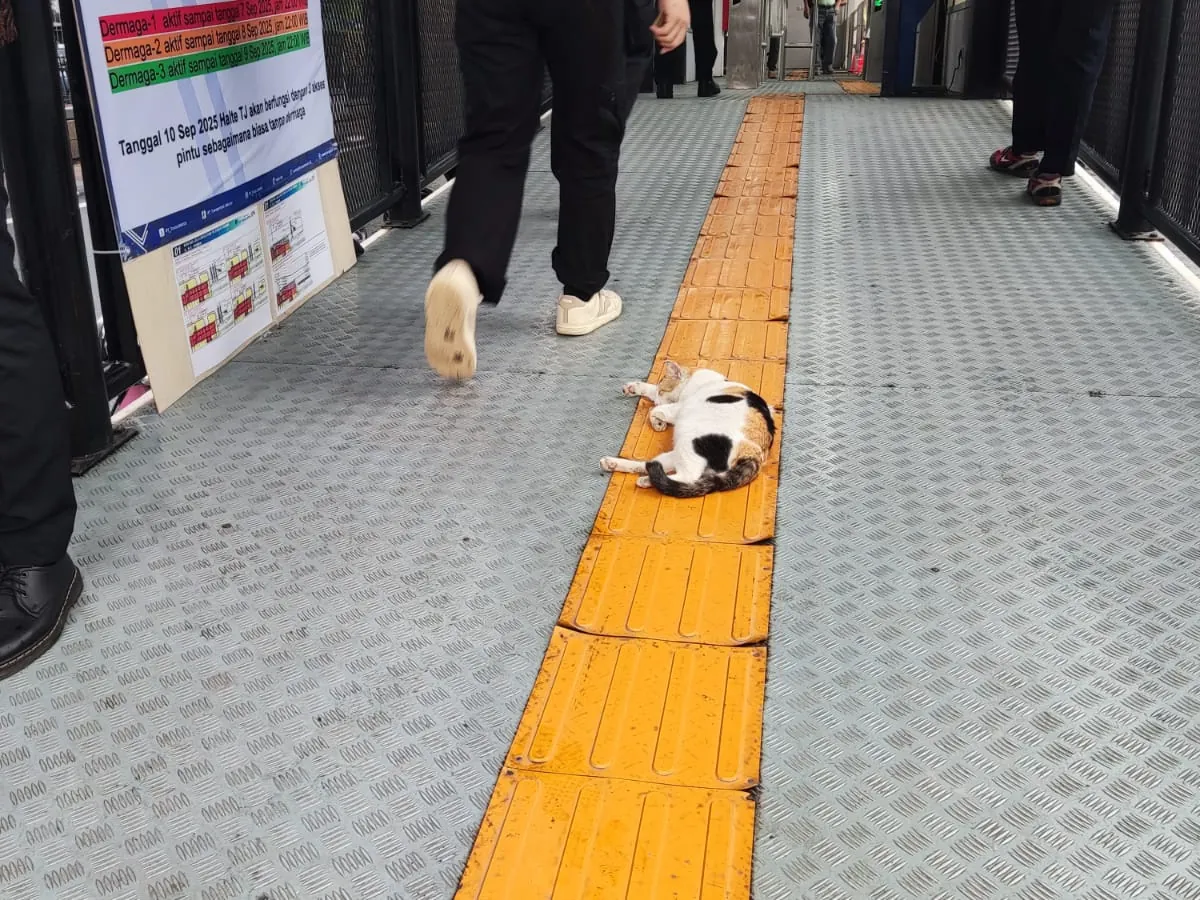
More than a year after Jakarta's governor floated the idea of a "cat island," Pulau Tidung Kecil in the Thousand Islands (Kepulauan Seribu) remains empty of cats. Governor Pramono Anung described the cat-tourism project as "under review" in June 2025, and that answer has not changed as of mid-2026. The program that has actually moved is one that barely made headlines: a mass sterilization drive targeting 22,000 cats in Jakarta last year.
The idea grew from real resident complaints. Reports about stray cats dominated submissions on JAKI, Jakarta's official city services app, from requests for sterilization to calls for proper shelters. Pramono responded with an idea that spread quickly online: convert one of the Thousand Islands into a cat destination modeled on Aoshima, Japan. Muhammad Fadjar Churniawan, the acting regent (Plt Bupati) of Kepulauan Seribu, said a survey had already narrowed the choice: "Of the four islands we surveyed, Pulau Tidung Kecil is the most appropriate and suitable."
Aoshima's appeal is visual. The small Japanese island's cat population far outnumbers its human residents and draws international visitors. But Aoshima's cats grew there organically on an inhabited island. They were not mass-relocated to an area previously designated for conservation.
Why is Pulau Tidung Kecil a problematic site?
Pulau Tidung Kecil's status as a conservation zone under Jakarta's Regional Spatial Planning Regulation (Perda RTRW) conflicts directly with its use as a large-scale cat shelter. In 2019, Jakarta's Agriculture and Food Security Agency (Dinas KPKP) released kutilang birds on the same island as part of a species conservation program. Placing hundreds of cats there would introduce a natural predator into a habitat under active recovery.
Francine Widjojo, a member of Commission B of the Jakarta Regional Legislative Council (DPRD DKI) from the PSI party, stated her objection plainly: "If a large number of cats are relocated there, they will become invasive predators and can damage the ecosystem in Pulau Tidung Kecil, which is mandated to be a conservation center under the RTRW Regional Regulation."
There are also technical problems separate from conservation. Cats are territorial: any area where they are removed will quickly be repopulated by others from surrounding neighborhoods. Mass relocation does not address the source of population growth in the communities the cats came from.
Sterilization: the concrete program that never went viral
Sterilization is a medical procedure that ends a cat's ability to reproduce, so the existing population does not grow from within. Pramono identified it as the primary path forward: "The most important thing is that these cats are multiplying too fast, so sterilization will definitely continue."
The target of 22,000 cats set by the KPKP Agency for 2025 exceeded any figure that had made it into major news coverage. Pramono stated it himself: "We are targeting 22,000 this year. Hopefully, with sterilization, Jakarta's cat population will decrease." Whether the target was met has not been publicly announced.
Francine also pushed an infrastructure-based approach: "The long-term solution to cat population control in an area is sterilization, not relocation." Under regulations from Indonesia's Ministry of Agriculture, DKI Jakarta with its 44 sub-districts should ideally have at least 15 animal health centers (puskeswan), a figure that also featured in Pramono's campaign promises but has not yet been delivered.
Three open questions
Pramono has not formally closed the cat island project. His statement in June 2025 left room: "We are now reviewing it. No decision has been made. It is under review." On another occasion, he said policies that do not make sense need not be forced through.
Three things will determine where this goes: first, a formal decision from a review that has now run for more than a year; second, the actual sterilization numbers against the 22,000-cat target, the only measurable population-control benchmark available; third, whether the 15-puskeswan pledge is delivered as an institutional alternative. Of the three, only sterilization has a stated target and a clear implementing framework.



Comments