

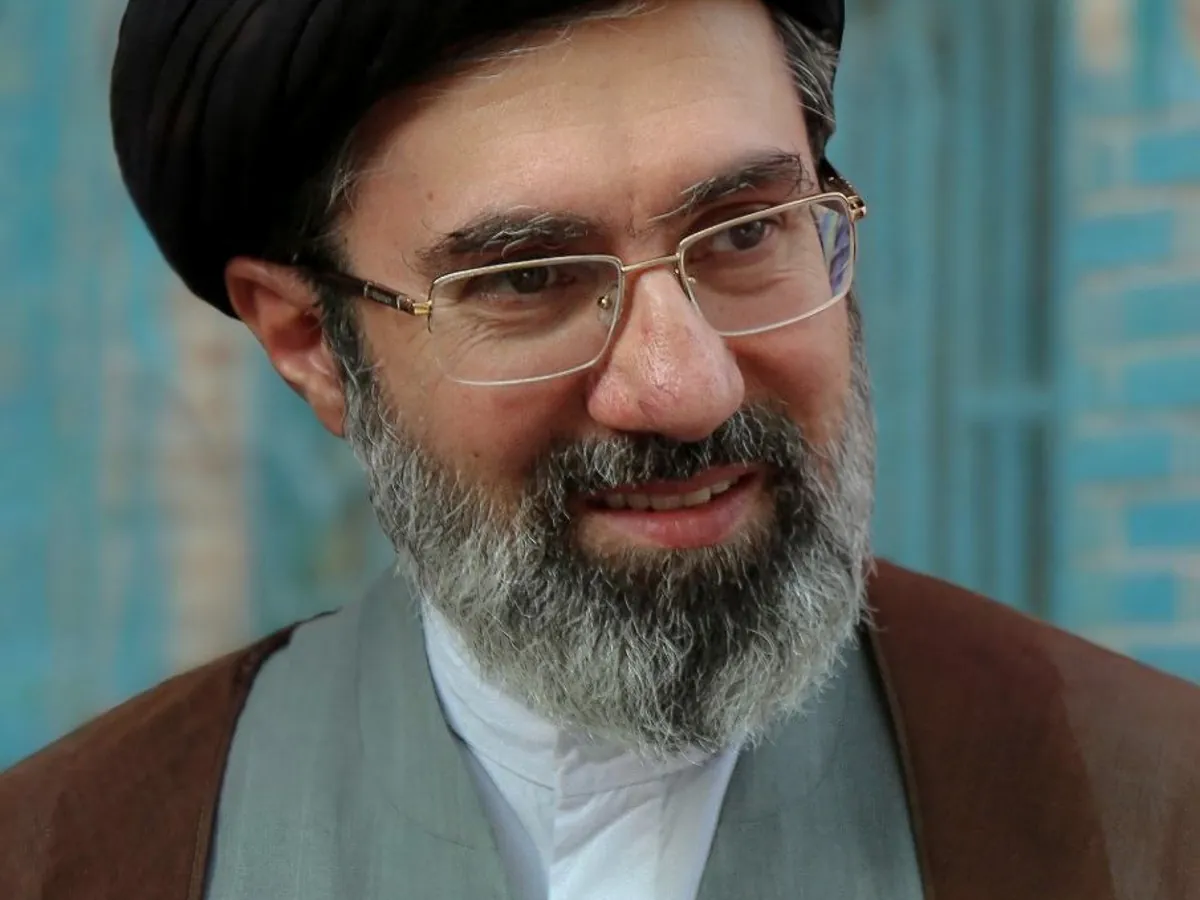
The coffin of Ali Khamenei began moving through Tehran's main boulevards on Monday morning, July 6, 2026, in a procession the government expects to draw 15 million mourners over six days. Among all the faces filling the capital's streets, one was absent: Mojtaba Khamenei, the son who has held Iran's supreme leadership since March 2026.
The coffin left the Grand Mosalla complex, where the body had lain in state for two days, on a roughly 12-hour journey to Mehrabad International Airport. Crowds dressed in black lined the route, waving flags. Effigies of Donald Trump were hung at several points; posters of U.S. Vice President JD Vance, Defense Secretary Pete Hegseth, and Israeli Prime Minister Benjamin Netanyahu circulated bearing the words "There will be blood."
Iranian Army Chief Major General Amir Hatami addressed the mourners: "Those who committed this crime must know that the nation of Iran and all of us will never cease in our pursuit of and demand for justice." A 38-year-old man in the crowd told AFP: "The killers [of Khamenei] must face punishment."
Bigger than Khomeini in 1989, and more controlled
The funeral of Ayatollah Ruhollah Khomeini in June 1989 holds a Guinness World Record: roughly 10.2 million mourners, about 16 percent of Iran's population at the time. The two-day procession inside Iran ended in chaos when crowd pressure forced the coffin to be airlifted by helicopter.
Iran's government designed a different format for Khamenei: six days, two countries. After Tehran, the procession moves to Qom on Tuesday, July 7, then to Najaf and Karbala in Iraq on Wednesday, July 8, before concluding in Mashhad on Thursday, July 9. The 131-day delay since his death on February 28, 2026, justified on post-war security grounds, gave organizers time to plan logistics at this scale.
Khamenei died on the opening day of a five-week war between Iran and a combined U.S.-Israeli force, aged 86, after nearly 37 years in power. Family members reported killed in the same strike include his daughter, a son-in-law, a daughter-in-law, and a 14-month-old granddaughter.
Why is Mojtaba Khamenei absent from his father's funeral?
Reuters reported that Mojtaba suffered serious injuries in the February 28 strike that killed his father: his face was disfigured and one or both of his legs were severely injured. Since the Assembly of Experts appointed him as the new supreme leader in March 2026, Tehran has released no public appearances or official images of him.
Three of Khamenei's other sons, Mostafa, Meysam, and Masoud, prayed near the coffin on Sunday, July 5. Parliament Speaker Mohammad Bagher Ghalibaf praised the "proud and invincible Islamic nation of Iran" paying tribute to the "martyr." Mojtaba was not among them.
For decades, Iranian officials rejected father-to-son succession as "dynastic." When it finally happened in the middle of a war, the man who rose to power is the one least seen in public.
This procession is designed as a post-war show of strength: millions in Tehran's streets to demonstrate that the Islamic Republic remains intact after its leader was killed and its capital bombed. The crowds prove that mass mobilization is still possible. The narrative the government is building centers on Khamenei's martyrdom, not on his successor's presence.
For Indonesia, two direct channels connect Tehran to Jakarta: oil prices that track Gulf stability, and the religious travel routes that pass through Iraq, including Najaf and Karbala, two stops on this week's procession. The Strait of Hormuz, which Iran declared closed during the war, remains a tension barometer that has not fully settled.
Before the final burial in Mashhad on Thursday, July 9, one question remains: whether Mojtaba Khamenei will finally appear in public.
Comments