

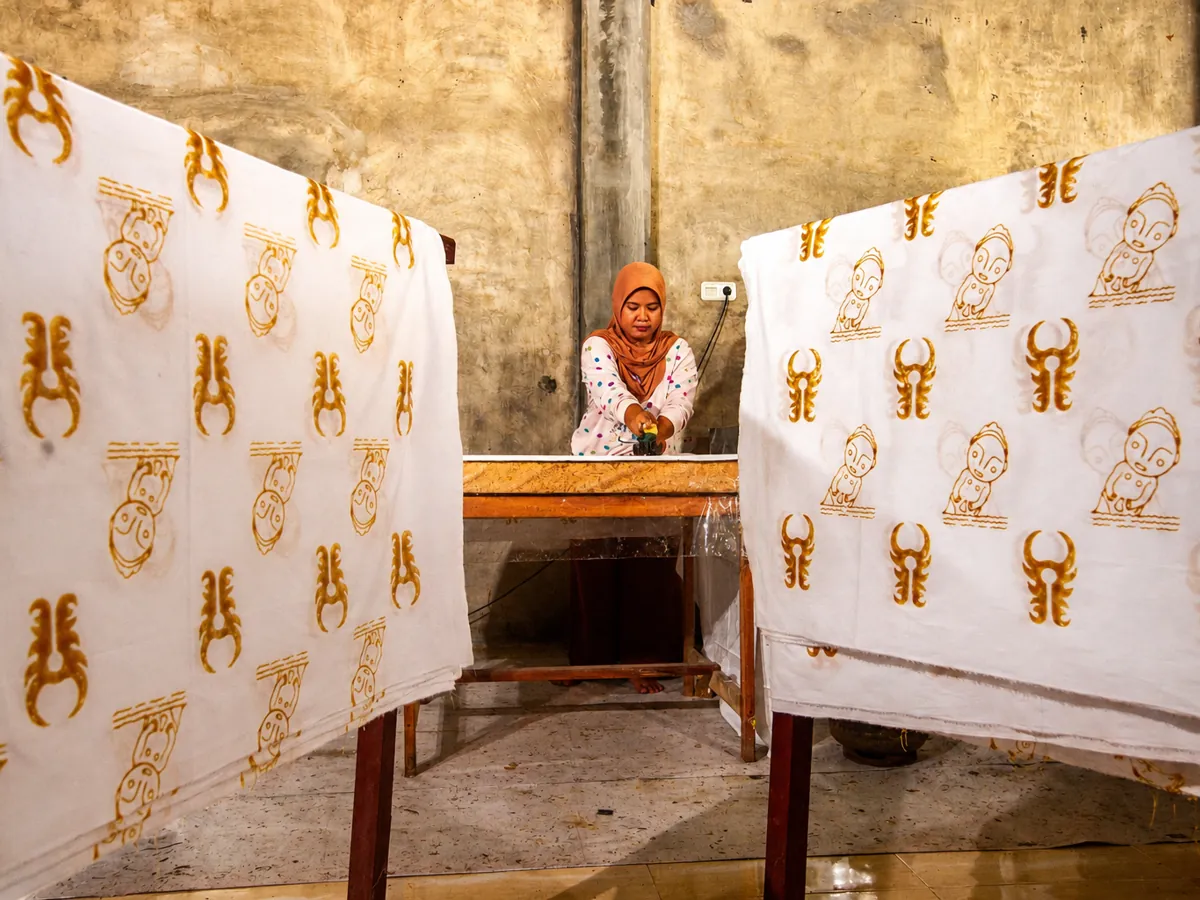
In Kabupaten Sigi, Central Sulawesi, a tour through Batik Valiri starts in a community-guarded forest and ends with a length of hand-dyed cloth. Visitors walk Hutan Ranjuri, learn which plants yield natural color, absorb the philosophy behind Kaili motifs, and try the batik process themselves.
Here, travel becomes a way to read how a community relates to its forest, its culture, and its local economy. A length of cloth is a product. It is also a way into the place, the people, and the nature that produced it.
Batik Valiri is based in Desa Beka, Kecamatan Marawola, Kabupaten Sigi. The centerpiece is Hutan Ranjuri, a roughly 9-hectare forest maintained for generations under customary law. The forest is an ecological buffer against flash floods and drought, a source of clean water, a source of inspiration for motifs, and a source of natural dye materials.
Valiri comes from the Kaili word meaning "born here," referring to the area around Hutan Ranjuri where the community has long made its living, practiced its culture, and maintained local knowledge systems.
Scattered megalithic traces
Founder Afrianto, known as Anto, started Batik Valiri in 2019 after years working at a batik shop in Palu. He saw that Sigi's natural and cultural wealth had barely been represented in batik.
"Batik has long been associated with Javanese motifs. But in Sigi, we have very strong natural, cultural, and historical wealth. From Hutan Ranjuri alone, which is only about fifty meters from the production site, I could see many things worth lifting into cloth, including natural dyes that can be developed from the plants in that ancient forest," Anto said.
What sets Batik Valiri apart is its motifs. Each pattern carries philosophy and regional identity rather than serving as decoration. The taiganja motif, for example, symbolizes fertility and expresses love and sincerity. In Kaili tradition, taiganja is a sacred pendant-like object used in ceremonies and often given as a wedding dowry. Through Batik Valiri, its meaning, increasingly unfamiliar to younger generations, is brought back into a contemporary cultural context.
Beyond taiganja, Batik Valiri draws on the Rau tree from Hutan Ranjuri, moringa leaves, the traditional weapon guma, and megalithic traces found across Sigi. All become entry points into the natural, social, and historical wealth of the district.
On the production side, Batik Valiri combines stamp (cap) and hand-drawn (canting) batik techniques with contemporary approaches such as abstract brushwork and splatter batik (ciprat). Natural dyes come from the biodiversity of Hutan Ranjuri: rau leaves yield cream tones, mango leaves produce yellow-green, while teak and ketapang leaves create reddish-brown and black hues.
Natural dyeing takes time. Ten kilograms of dried leaves dye about five cloths, requiring up to four hours of boiling and as many as twenty successive dips for color to fully absorb.
"With synthetic dyes, one dip is enough. But natural dyes require patience. That is what makes the value different," Anto said.
In sourcing raw materials, the customary community of Desa Beka takes only fallen leaves, cutting no trees. Management of Hutan Ranjuri goes through deliberation with customary leaders, and any activity in the area requires customary permission. Administratively the forest holds productive forest status, but socially it is maintained as a sacred space and a source of livelihood. When flash floods struck Sigi, the forest was a natural buffer. During drought, residents drew clean water from the same area.
Ecotourism package
Batik Valiri is now being developed as part of an experience-based ecotourism package. Visitors walk Hutan Ranjuri, learn the philosophy behind the motifs, and try batik-making themselves. The concept has been piloted in several local, national, and international events as an effort to integrate natural, cultural, and economic potential into one system.
Batik Valiri's development was also shaped by the Gampiri Interaksi incubation program. When the workshop started, Anto was still using synthetic dyes due to limited knowledge, market access, and technical support. A significant shift came when Batik Valiri joined the program.
Through eight months of intensive mentorship, Gampiri Interaksi helped Batik Valiri strengthen its institutional governance, set production standards, build human resource capacity, and open access to markets and capital. The mentorship aligned with a push from the district's Environment Agency (Dinas Lingkungan Hidup), which in 2024 encouraged the use of natural dyes from Hutan Ranjuri.
"Batik Valiri was already strong socially and culturally, but its environmental aspect needed strengthening. Through workshops and collaboration, we encouraged the transition to natural dyes without damaging the ecosystem," said Nedya Sinintha Maulaning, a representative of Gampiri Interaksi.
Natural dye workshops brought in Batik Valiri employees and village residents. They learned color extraction techniques, natural mordanting using materials such as lime paste (kapur sirih) and an iron mordant (tunjung), and the importance of regenerating dye plants. As part of a sustainability commitment, mango, ketapang, and teak trees were replanted in the Ranjuri area, and a tree adoption program covered around 50 trees in 2023.
International interest
Batik Valiri is now part of Sigi's transformation into a sustainable district, bringing an economic practice rooted in local values and environmental stewardship. By strengthening community-based enterprise, using resources wisely, and creating added value at the local level, Batik Valiri contributes to a restorative economy that raises community income while building the district's social and economic resilience.
Through the networks of Gampiri Interaksi and Lingkar Temu Kabupaten Lestari (LTKL, the Sustainable Districts Network), Batik Valiri is marketed via Instagram and is often the official souvenir for cross-provincial visits and international partnerships. Visitors have come from Brazil, the United States, Japan, and several other countries to learn about the process and shop directly.
For Gampiri Interaksi and LTKL, Batik Valiri is a concrete example of restorative economics in practice. When the forest is protected, culture is revived, and the community is involved, prosperity can grow without choosing between economy and environment. In Sigi, where roughly 70 percent of the territory is forest, practices like this show that natural recovery can be the foundation of economic recovery.
A visit to Batik Valiri is a way to understand how nature, customary law, hand skills, and the local economy can coexist in one story. From Hutan Ranjuri to a length of cloth, visitors take home more than a product. They take home an understanding of how culture and nature are kept together.


Comments