
Four Iranian drones shot down, six of seven ballistic missiles intercepted before they could hit Kuwait and Bahrain, and then US fighter jets striking back at Iranian coastal radar sites in the city of Goruk and on Qeshm Island. The chain of events that unfolded on Friday, June 5, 2026, and carried into the next day, has dragged the Strait of Hormuz back to a boiling point, and the tremors are being felt all the way to the petrol pumps and budget tables in Jakarta.
US Central Command (CENTCOM) described the Iranian drone strikes as a direct threat to shipping in the region. "The attack drones posed an immediate threat to regional maritime traffic," the command said in an official statement. The incident has shaken a fragile ceasefire in place only since early April, and global markets read it as a single, blunt signal: the risk to oil supply has not gone away.
What happened in the world's narrowest strait
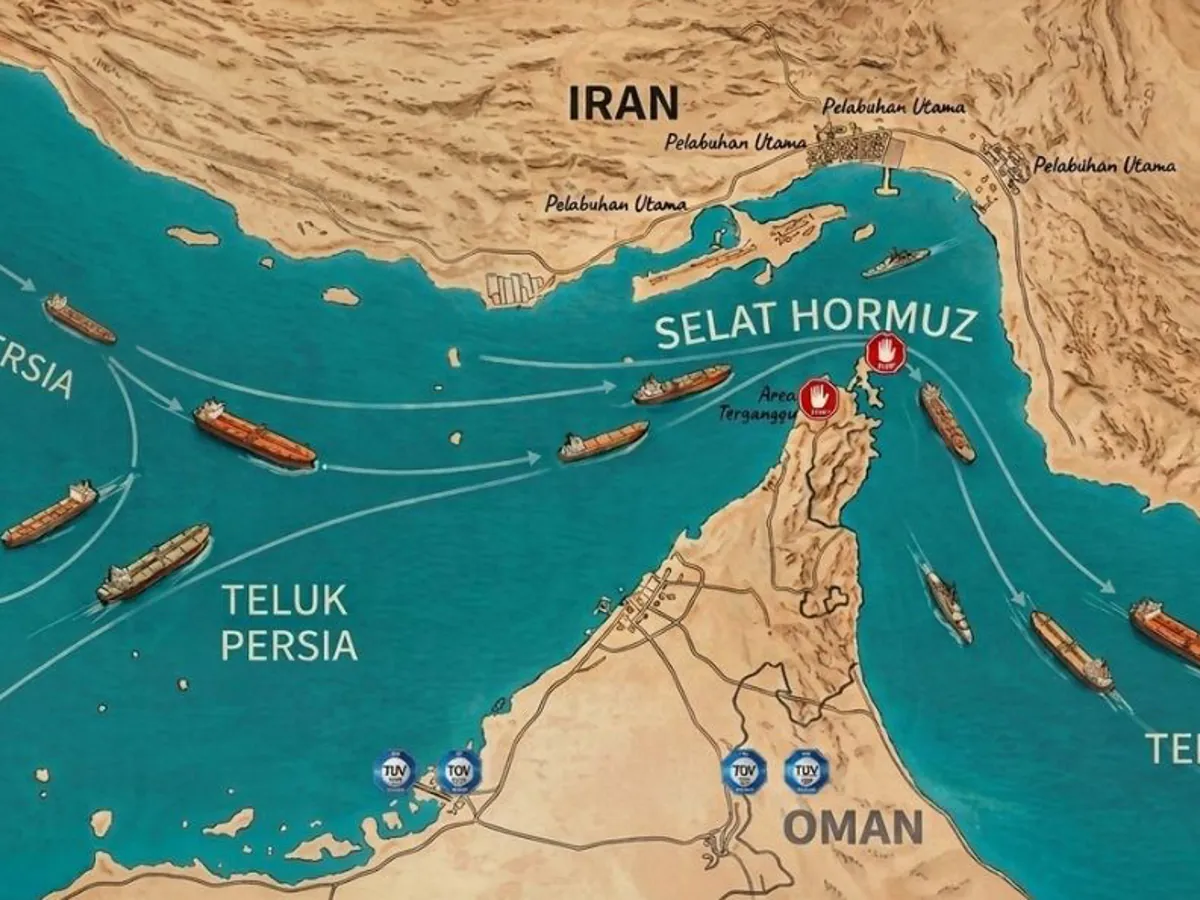
The Strait of Hormuz is a tight corridor linking the Persian Gulf to the Gulf of Oman, and under normal conditions roughly a fifth of the world's seaborne oil and liquefied natural gas passes through it. There is no comparable alternative route. That is why any flare-up in these waters travels straight to energy prices around the globe.
Since late February 2026, when the US and Israel began an air campaign against Iran, traffic through the strait has been largely paralyzed. Crisis chronologies put the start of the blockade at around February 28. Iran has since relied on sea mines, drone strikes, and threats against tankers as instruments of pressure, while the US has mounted a large military operation to reopen the Gulf's oil export lanes.
The scale of that operation has not been small. CENTCOM spokesman Navy Captain Tim Hawkins set out the kinds of targets US forces have hit around the strait. "Targets included missile launch sites and Iranian boats attempting to emplace mines," he said. In separate remarks cited by RFE/RL, and not independently confirmed, senior US military official Admiral Brad Cooper was said to have stated that US forces have struck a large number of Iranian military targets, including several vessels, over the course of the campaign.
A ceasefire that never quite held
The agreement to halt the fighting was reached around April 8, 2026. On paper, the pause was meant to ease tensions. In practice, follow-on attacks have kept testing its durability, and the June 5–6 incident is the latest sign that the hostilities have not truly died down.
Talks held in Doha, Qatar, have yet to produce a permanent deal. Iranian Foreign Ministry spokesman Esmaeil Baghaei reportedly said most of the issues in the negotiations had been resolved, but that a final agreement was not close. That position captures a familiar deadlock: enough progress to keep both sides at the table, but not enough to silence the gunfire on the ground.
From Washington, the signal sent by President Donald Trump was both confident and restrained. Speaking from the Oval Office, he described Iran's nuclear program as already neutralized and suggested the US saw no reason to go further. "We could get it right now. I don't think they could stop us if we wanted, but there's no reason to. It's entombed," he said. On one hand, such language hints that the US has no intention of widening the war. On the other, rhetoric that emphasizes military dominance makes it harder for Tehran to back down without losing face, a dynamic that keeps de-escalation elusive.
Why Jakarta is nervous too
Indonesia has no ships sailing through Hormuz, but it is tightly bound to the prices set there. The country still depends on oil imports, so every rise in the global benchmark immediately swells its energy import bill, adds to the subsidy burden, and widens the current account deficit.
How high prices can spike was already on display at the peak of the first crisis in mid- to late March. Brent briefly broke into the range of $126 a barrel, while the Middle Eastern grades Indonesia leans on more heavily, such as the Dubai benchmark, surged even more sharply to around $166 a barrel. That is far above the Indonesian Crude Price (ICP) assumption of around $70 a barrel written into the 2026 state budget, and beyond even the $100-a-barrel scenario the government uses when calculating its subsidy load. A gap of tens of dollars, multiplied by daily import volumes, means a steep added cost to the state's coffers.
The pressure has come at a bad time. The rupiah touched its weakest level on record, around Rp18,000 to the dollar, in early June, and the Jakarta Composite Index slid to its lowest since 2021. An escalation in Hormuz risks deepening risk-off sentiment toward emerging-market assets, and Indonesia is among the most exposed to foreign capital outflows when global investors panic. Expensive oil and a weak rupiah pull in the same direction, both eroding purchasing power and straining macroeconomic stability.
The government stands firm on fuel prices
Facing that double pressure, the government has chosen to reassure the public on the front households feel most directly: the price of fuel. Finance Minister Purbaya Yudhi Sadewa insisted the domestic economy's foundations remain solid even as the geopolitical storm rages abroad.
"Amid the global uncertainty caused by geopolitical escalation and pressure on world activity, Indonesia's economic stability remains intact," he said. On prices at the pump, he offered a more specific guarantee. "Subsidies on fuel will continue to be provided through the end of the year, and the price of subsidized fuel will not rise," Purbaya said.
That pledge is more than words. In early June, the national price of jet fuel fell by as much as 10% effective June 1, 2026, tracking a dip in global energy prices at that particular moment. The drop shows that world oil prices have not moved in one direction throughout the crisis; there have been stretches when supply flowed again and prices eased, giving the government room to trim some non-subsidized fuel costs.
But this is where the trade-off lies. Holding subsidized fuel prices low while world oil prices are high means the state absorbs the difference through a swelling subsidy. The policy protects household spending power, but shifts the burden onto the state budget, which is already strained by a weak rupiah and costly energy imports. The claim that fiscal space remains adequate, as the Finance Ministry maintains, will keep being tested if Brent climbs back toward the peak it touched in March. The stability being promised, in other words, depends on how long and how severe the Hormuz crisis turns out to be.
What will set the course ahead
A few pressure points will determine whether this strain eases or hardens in the weeks ahead. The first is the fate of the ceasefire itself: whether the June 5–6 attacks trigger a larger reprisal, or instead push both sides to speed up a compromise in Doha. Each new round of fighting will show up immediately in the price of Brent and WTI, and from there bleed into the state budget and the rupiah's exchange rate.
Shipping security is the second point. The status of the Hormuz blockade and the safety of tankers touch not only crude prices but also marine insurance premiums and the steady flow of liquefied natural gas to Asia, including to the large consumers that are both Indonesia's trade rivals and its partners. At home, the next moves by the Finance Ministry, Bank Indonesia, and state energy firm Pertamina to defend foreign reserves, currency stability, and fuel supply and prices will decide how well the domestic shield holds.
The last point is diplomatic. The stance of Gulf states such as Kuwait, Bahrain, and Qatar, some of them targets of the missiles and hosts of the talks at the same time, will help shape the escalation map. So will the positions of Iran's allies and partners. For Indonesia, a crisis unfolding thousands of kilometers away carries an old lesson made relevant again: the price of global energy security is often paid at the fuel-station till and on the budget ledger of a country that had no part in the fighting.