
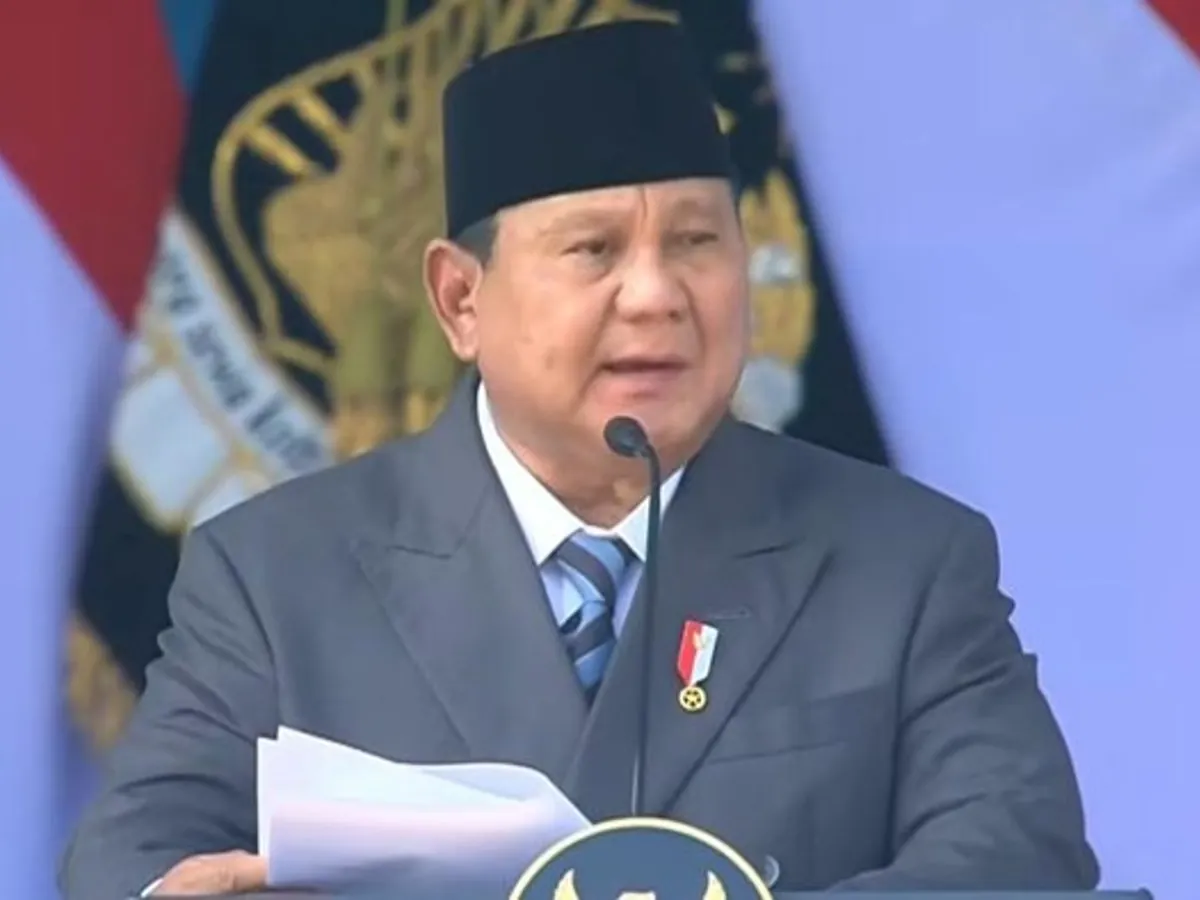
President Prabowo Subianto told Indonesia's National Police that public trust is their most powerful weapon, warning officers against criminalization, abuse of power, and placing themselves above the law. He delivered the message at a Bhayangkara Day (80th anniversary) ceremony held at the Brimob Training Unit in Cikeas, Bogor, on Wednesday.
For the first time, the ceremony was not held at the National Monument in Jakarta. Vice President Gibran Rakabuming Raka attended the event, themed "80 Years of Police Service to Society."
Prabowo laid out six key directives for the National Police (Polri): earn public trust, stay close to the people, enforce law fairly, master science and artificial intelligence, strengthen coordination with the military and government, and remain humble while continuously improving.
What are Prabowo's six messages to the police?
The president opened with a blunt reminder about the source of police authority. "Remember, our salary as public officials comes from the people," he said. Officers serve citizens, not themselves.
On the rule of law, Prabowo was equally direct. Police cannot enforce law that is "sharp on the poor and dull on the rich," he said. Law must not become a tool for the wealthy or a weapon for political revenge.
Most pointedly, he addressed the public's deepest complaints about the force: "There must be no criminalization. There must be no abuse of power. No one should be above the law."
Message on criminalization amid Police Law revision
Prabowo's warning carries particular weight this year. The government is revising the Police Law, a process that has sparked debate over expanding police authority versus strengthening civilian oversight. Meanwhile, accusations of forced abductions have damaged the force's reputation. The phrase "people's police" itself has become a flashpoint in that legislative revision.
The president's direct call for an end to criminalization and equal application of law spoke directly to public grievances that advocacy groups have amplified. What remains unclear is whether his verbal directive will translate into measurable instructions from the police chief or concrete evaluation programs in the coming months.
Order to master artificial intelligence
Prabowo's fourth message was the most specific about new capabilities the police must develop: "Master knowledge. Master technology. Master artificial intelligence. Crime now and in the future can only be defeated by officers who always learn, who are intelligent and who are reliable."
The context is concrete. Digital fraud, data breaches, and banking malware have become the fastest-growing categories of crime, demanding technical skills beyond traditional policing. Whether Prabowo's message will be followed by training budgets, adequate cyber units, or technical cooperation with relevant agencies remains a key test of follow-through.
The directives are now official orders from the head of state to more than 400,000 Polri personnel. The real measure of their impact will come in how cases are handled, how quickly complaints are answered, and how transparent the force becomes in the months ahead.