
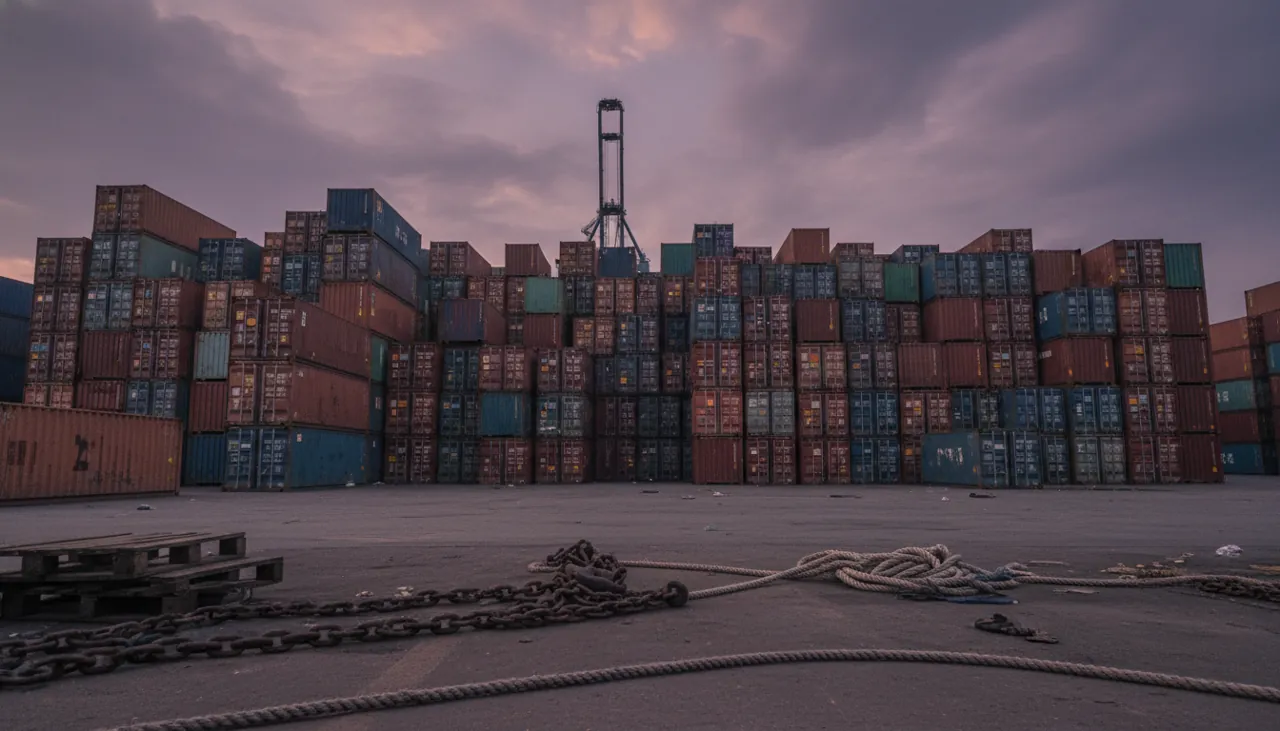
The figure Finance Minister Purbaya Yudhi Sadewa brought back from Tanjung Priok on Saturday, June 6, 2026, sounded alarming enough: roughly 3,000 containers waiting for document processing, enough to lengthen dwelling time and, in his words, beginning to choke the flow of raw materials to factories. His order was blunt and immediate—add staff, run two or more shifts around the clock, until the queue falls back to a normal level of about 500 containers. But the 3,000 were only the visible part. Behind a paperwork backlog that overtime can trim sits a far larger problem: 17,835 containers that have piled up for months inside the Priok customs zone for reasons no amount of extra working hours can fix.
Three thousand you can see, seventeen thousand you cannot
The gap between those two numbers is what reveals the real trouble. Logistics records as of June 5, 2026, counted 17,835 containers classified as longstay—held more than three days across Priok's various container terminals. That is nearly six times the queue that prompted Purbaya to step in. The difference is fundamental. The 3,000 are stuck on customs desks and can be cleared by adding hands to process documents. The tens of thousands of longstay containers, by contrast, have mostly already passed inspection. More than half, according to a Priok business operator who declined to be named, should have left the port's primary yard, having already obtained a release order (SP2B).
In other words, the goods are cleared to be hauled away but are not being hauled away. This is where overtime loses its power. Officers working double shifts can speed up document approvals, but they cannot force importers to come and collect containers that are being left at the port on purpose.
When the penalty is cheaper than a warehouse
Purbaya himself named the motive plainly when asked why goods were being left to pile up. "Maybe because the fine is cheaper. They just leave their goods here," he said during the inspection. That short remark captures the heart of a problem the 24-hour work order does not touch: for some importers, Indonesia's busiest port serves as a low-cost warehouse. As long as the storage rates charged by the port operator stay cheaper than renting a warehouse elsewhere, keeping goods at Priok is a rational economic choice, even as it gums up the port as a whole.
That logic explains why adding service hours will not reach the core of the matter. Until the cost structure changes, speeding up customs processing only means containers move faster from the "awaiting processing" category into the "cleared but abandoned" one. The document queue that angered Purbaya could vanish within days, while the larger longstay pile stays put. That is why, during the same inspection, Purbaya issued a second order that may matter more: he asked his staff to review the regulations. "I just asked Pak Djaka and the team, and the Secretary-General, to look at the rules and to draft a regulation, a kind of punishment, for people who leave their goods that long," he said.
A hidden tax borne by consumers
Long dwelling time is not merely a technical port matter. It is a cost that seeps everywhere. Every extra day goods are held adds to logistics expenses, and those expenses end up attached to the prices consumers pay. For manufacturers the impact is more direct: a stalled supply of raw materials, as Purbaya acknowledged, can force factories to adjust production schedules at a time when household purchasing power is already weak.
The timing is unhelpful too. The swelling logistics bill arrives while the rupiah is under pressure and the trade balance is being leaned on to prop up the exchange rate. An inefficient port erodes export competitiveness precisely when exports are most needed to steady the rupiah. The container pileup at Priok, then, is not a local problem that stops at the port gate; it travels through to market prices and into the figures on the balance of payments.
To gauge how serious this surge is, it helps to look at the historical numbers. Academic studies put the average import dwelling time at Priok between 2015 and 2020 at around 3.63 days, ranging from 2.87 days at best to 4.28 days at worst; another study spanning seven years found an average of roughly 5.5 days. The government has long set a target of under three days as its efficiency benchmark. Against that yardstick, the pile of 17,835 containers in early June suggests an old problem that was never truly resolved is worsening again. These study figures should be read as a sign of the trend rather than an official up-to-date snapshot, since neither Customs nor Pelindo has issued a single release confirming the latest position.
A question of trust, not just speed
There is another layer that makes this overhaul harder than a matter of rates and working hours. The man Purbaya asked to fix the storage rules, Director General of Customs and Excise Djaka Budhi Utama, is himself under scrutiny. Djaka, who was sworn in on May 23, 2025, has been named in the indictment of an alleged import bribery case at the Corruption Eradication Commission (KPK) involving PT Blueray Cargo, with the figure cited at around Rp61 billion. He has not been named a suspect, and Purbaya has chosen not to suspend him, citing the early stage of the trial.
That puts the reform of port governance in a double bind. The essence of the punishment scheme Purbaya wants to build is to give customs authorities greater power to penalize importers who abandon their goods. But such power only works if it is trusted, and trust is being tested precisely by the legal case shadowing the institution's top official. Fixing the port, in short, cannot be separated from fixing the credibility of those who guard it.
What is actually keeping containers in
Some of the obstacles are technical and not always the importer's fault. Dwelling time in fact breaks into three stages: pre-clearance, when documents are handled before goods arrive; customs clearance, when Customs checks documents and the physical cargo; and post-clearance, when the owner collects the goods. The latest pileup is clotting at the third stage. Some containers already cleared for release are held up by a sluggish Storage Relocation (PLP) mechanism—moving containers from a congested terminal to a Temporary Storage facility (TPS) in the secondary yard.
Heru Susanto, head of the Tanjung Priok Harbormaster and Port Authority office (KSOP), proposed two ways out aimed at this bottleneck: speeding up the PLP of containers to the secondary-yard TPS, and speeding up the removal of empty containers that also crowd the terminal. The proposal rounds out the picture that breaking up the Priok pileup needs several parties working at once, not Customs alone. Terminal operators, KSOP, and importers each have a role, and the overtime order touches only one of them.
What to watch
In the coming weeks, the first test is whether the document queue, which stood at 2,500 during the inspection, really falls to around 500 as targeted, and how long the 24-hour shifts can hold it there. The more decisive test is the fate of the promised punishment regulation: how large the fine will be, how it will work, and when it takes effect. Until that rule is issued, the change to the cost structure at the root of the problem remains only a plan.
Beyond that, two things deserve watching. First, whether the faster PLP to the secondary-yard TPS that KSOP proposed is actually carried out by terminal operators, because that is where thousands of containers with release orders are stuck. Second, the progress of the legal case shadowing Director General Djaka, since the credibility of the governance overhaul will be weighed there too. The 24-hour work order may clear the visible queue within days. But the question left by those 17,835 containers is harder to answer with working hours: how to stop the port from serving as a cheap warehouse, and how to make the rule meant to discipline it trusted enough to enforce.