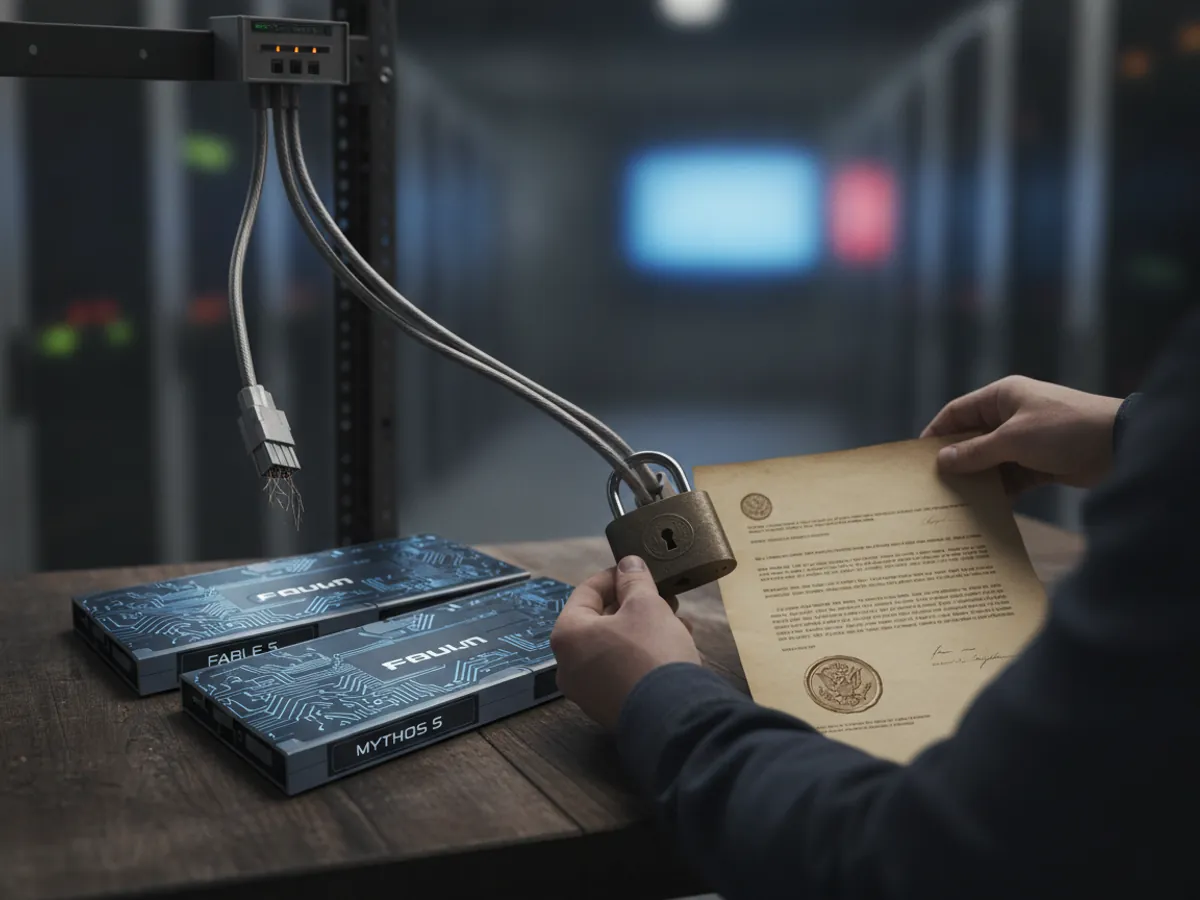


Anthropic shut down its two newest AI models, Fable 5 and Mythos 5, for every user worldwide on Friday, June 12, 2026, just three days after launching them. The cause was a U.S. government directive ordering it to block access for all foreign nationals, paired with the fact that Anthropic has no technical way to sort users by citizenship in real time. The order arrived at 5:21 p.m. Eastern time, and both models went dark that same evening, U.S. citizens included.
The order applied to every foreign national wherever they were, down to Anthropic's own foreign employees. With no way to verify the citizenship of millions of users in real time, the company could not block selectively. The only way to comply was to shut both models, live for barely three days, off for everyone.
"We are complying with the government's legal directive and are removing access to Fable 5 and Mythos 5 for all users," Anthropic stated.
Two Models, One Foundation
The two models share the same underlying architecture but aim at different users. Fable 5 was the public, guarded version, available through the Claude API and Enterprise plans, with limits around high-risk domains like cybersecurity and biology. When a conversation drifted into those areas, Fable handed the response off to Claude Opus 4.8. Anthropic says about 95 percent of sessions stayed with Fable itself.
Mythos 5 ran without the same guardrails. Anthropic limited its distribution to a handful of trusted partners, among them cybersecurity firms and critical infrastructure operators.
Neither model was cheap. Fable 5 cost $10 per million input tokens and $50 per million output tokens, twice the rate of Opus 4.8. Both launched on Tuesday, June 9, 2026, three days before the letter arrived.
Why All Users Were Affected
IP addresses and account types are easy enough for a system to filter. Citizenship is not. With millions of users, Anthropic had no way to check it in real time, which made any selective block impossible to carry out.
This is not like ordinary downtime. A crashed or overloaded server is something an engineering team can fix within hours. Access to Fable 5 and Mythos 5 comes back only if Anthropic and the U.S. Commerce Department find common ground, and that is well beyond what any engineer can do.
The Disputed Vulnerability
Axios reported that Commerce Secretary Howard Lutnick wrote directly to Anthropic CEO Dario Amodei. What set it off was a demonstration by another company that claimed to have gotten past the models' protections, specifically by "asking the model to read source code and fix software bugs."
Anthropic argues the government's response far outweighs the flaw. At launch it had already noted: "As well as internal testing, we ran an external bug bounty that produced no universal jailbreaks in over 1,000 hours of testing." After the shutdown, the company called the vulnerability "relatively simple" and confined to a small number of cases it already knew about.
It also pointed out that the capability flagged as a vulnerability already exists in other commercial models, including OpenAI's GPT-5.5. "The letter did not provide specific details of its national security concern," the company wrote. The order arrived without spelling out its legal basis.
For context, the Trump administration had reportedly tried to stop the two models from launching in the first place, and failed.
Export Rules Meet a Web Service
The government reached for export controls. Those rules normally cover physical goods: semiconductors, military parts, strategic machinery. Applying them to a SaaS product used by millions of people has almost no precedent.
The real difference is how fast it can be pulled. Chips under an export ban still sit in a warehouse, and stopping them takes transit time and border checks. An AI model can be switched off across every endpoint at once, in minutes. That speed, more than the legal framework, is what changes the risk math.
For developers and startups in Indonesia that build on the Claude API, whether directly or through tools like Cursor and AI-powered IDEs, the episode surfaces a risk few of them weigh when designing a system. Leaning on a single frontier model now also means carrying cross-border regulatory risk. It does not show up in an SLA or on a status page, and it can be set off by a decision in Washington that has nothing to do with their contract.
Anthropic warned that if the same standard were applied across the industry, it would stall nearly every new model launch from any frontier provider.
Several questions are still open: whether Anthropic and the Commerce Department can agree on a citizenship check that holds up technically and legally, whether Lutnick's letter will be made public with its full reasoning, and how OpenAI and Google will read the precedent. But one thing is already settled: for the first time, access to a frontier AI model can be revoked overnight by government order. That risk now attaches to anyone who builds a product on a single model.