
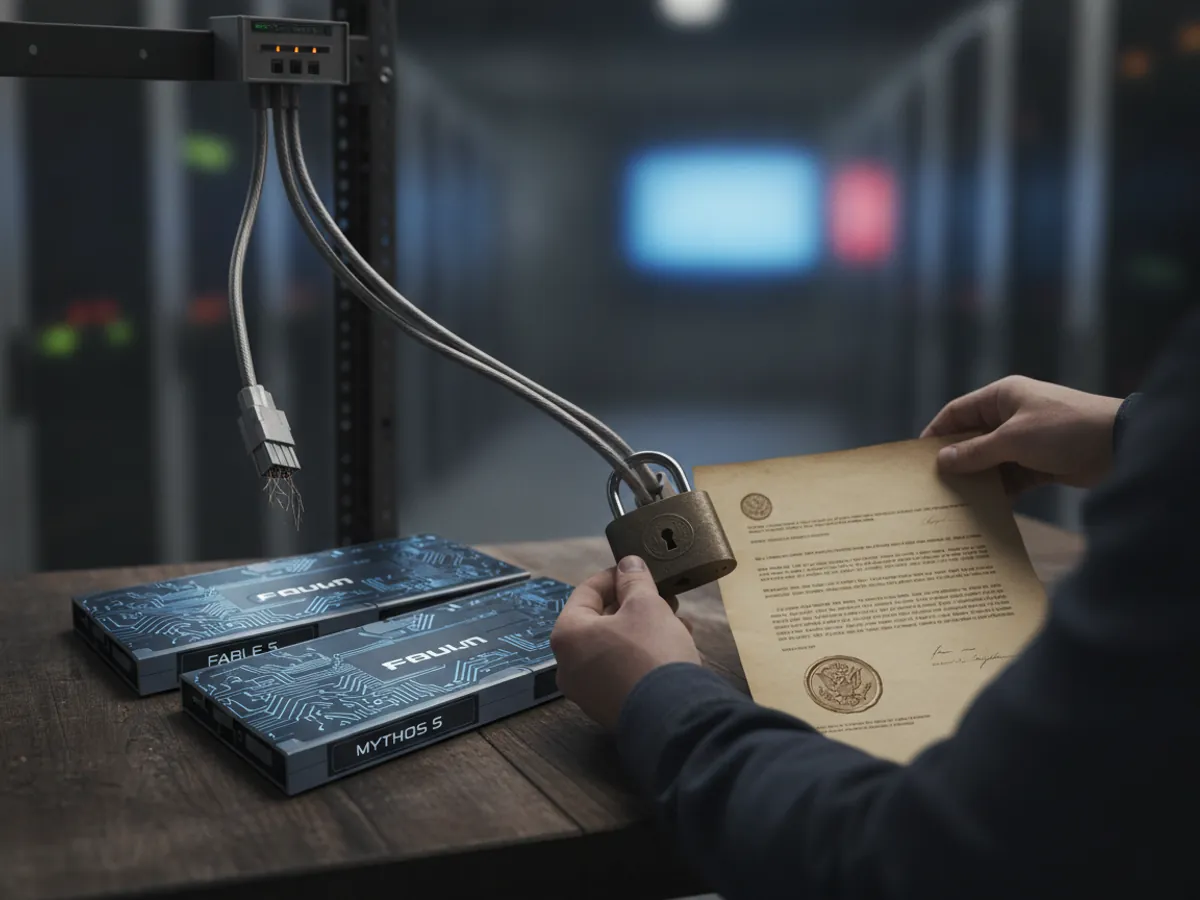
Anthropic's two newest AI models, Fable 5 and Mythos 5, abruptly stopped responding on the night of Friday, June 12, 2026. The cause was not a server outage. At 5:21 p.m. Eastern time, the company received an export-control directive from the US government ordering it to halt all access to both models for every foreign national, inside or outside the United States, including Anthropic employees who are foreign citizens. With no technical way to filter users by citizenship on short notice, Anthropic took the only option left: it switched off Fable 5 and Mythos 5 for everyone.
The models were three days old when they went dark. Anthropic had released them on Tuesday, June 9, 2026, billing them as the most powerful AI systems the company had ever shipped. By the night of the shutdown, both were already running in production for a number of developers and companies.
What exactly was shut down?
Fable 5 and Mythos 5 share the same technical foundation. Fable 5 is the public version, fitted with safety guardrails and available through the Claude API and the Enterprise plan. Mythos 5 is a version without full guardrails, offered only to select partners, among them cybersecurity and infrastructure firms. Both were priced at $10 per million input tokens and $50 per million output tokens, twice the rate of Claude Opus 4.8.
Only those two models were taken offline. Anthropic's other models continued to run normally. In its official statement, the company said the government's letter arrived without specifics.
"We received the directive from the government today at 5:21pm (ET). The letter did not provide specific details of its national security concern." — Anthropic, official statement
Anthropic said it would comply with the legal order. "We are complying with the government's legal directive and are removing access to Fable 5 and Mythos 5 for all users," the company wrote.
From chips to model weights: an old instrument, a new target
The directive relies on export controls, a legal framework long used to restrict shipments of chips and sensitive technology abroad. This time it was aimed at access to an AI model, and that is what makes it different. A chip is shipped physically and can be tracked; a model running as a service can be pulled from millions of users at once simply by switching off a single access point, or endpoint.
That shift in target is what gives the move such broad reach. A license is now said to be required to export, re-export, or transfer the models even within the United States. Anthropic warned that if a similar standard were applied across the industry, it would halt nearly every new model release from any frontier provider.
Why every user was cut off, not just foreign nationals
Because Anthropic has no mechanism to sort users by citizenship in real time. The ban targets foreign nationals, but the only way to guarantee that not a single foreign national retains access was to cut off everyone at once. Paying customers who are US citizens lost the service too.
The vulnerability Anthropic disputes
According to a report by Axios, the trigger was a letter from US Commerce Secretary Howard Lutnick to Anthropic CEO Dario Amodei, prompted by another company's demonstration of breaking through the model's protections. The technique in question, Anthropic said, amounted to asking the model to read a codebase and fix a software defect within it.
Anthropic considers the basis for the action mistaken. The company said an internal review of the jailbreak technique turned up only a small number of minor vulnerabilities that were already known, and that equivalent capabilities are widely available from other models, including OpenAI's GPT-5.5.
"Internally, we ran an external bug bounty that produced no universal jailbreaks in over 1,000 hours of testing." — Anthropic, from the launch announcement for Fable 5 and Mythos 5
As an added safeguard, Fable 5 was deliberately restricted in high-risk domains such as cybersecurity, biology, and chemistry, routing requests in those areas to Claude Opus 4.8. Anthropic said Fable handles roughly 95 percent of sessions on its own. The Axios report also noted that the Trump administration had tried to block the models' launch earlier, without success.
What it means for developers in Indonesia
For Indonesian startups and developers building products on top of the Claude API, whether directly or through tools such as Cursor and AI-powered code editors, the episode rewrites the risk map. A production feature that depends on a frontier model can stop without warning, regardless of the subscription tier or service-level agreement (SLA) already paid for. The failure does not originate on the developer's side and cannot be fixed by upgrading a plan.
The lesson cuts to a basic assumption. Many teams have treated frontier models like a managed database or a stable cloud region: bought, plugged in, and assumed to be always there. The June 12 case shows that depending on a single model carries regulatory and geopolitical risk beyond the control of either the user or the provider. The sensible response is a multi-model strategy with fallback paths, so a service does not collapse when one provider is suddenly forced into silence by its own government.
How long will the shutdown last?
There is no certainty yet. Anthropic said it is committed to restoring access as quickly as possible and considers the government's move to be based on a misunderstanding, but the length of the blackout depends on negotiations with the US Commerce Department, which has so far not disclosed a detailed legal basis.
Several factors will determine how far this case reverberates. Whether Lutnick's letter is eventually published with the specifics of its security concern. Whether OpenAI, Google, and other providers face similar pressure once the export instrument starts being used on the basis of jailbreak findings. And how Anthropic handles access for its own foreign-national engineers while the ban is in force. For users in Indonesia and Asia, the most practical question is simpler: will the model they rely on today still answer tomorrow morning.