
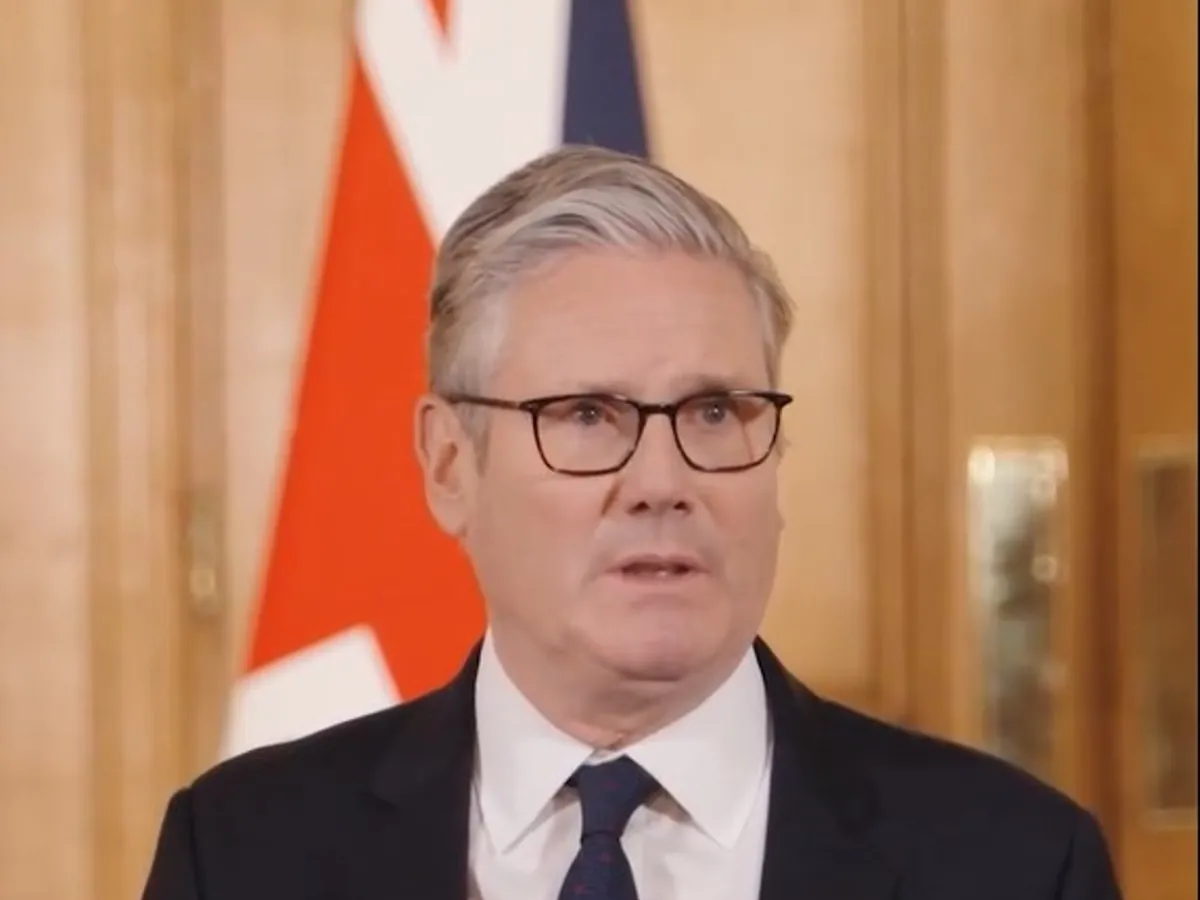
British Prime Minister Keir Starmer announced his resignation as Labour Party leader and head of government in a brief statement outside 10 Downing Street on Monday morning, June 22, 2026. The pressure that ended his premiership came not from the opposition but from the benches of his own party: Starmer said Labour MPs no longer saw him as the right person to lead them into the next national election, and he accepted that verdict "graciously."
Under the Westminster system, the office of prime minister belongs to the leader of the majority party in Parliament, so stepping down as leader automatically ends his term as head of government. Starmer said he had met King Charles III that morning to inform him of the decision and would stay on as caretaker prime minister until a new leader is chosen.
Less than two years earlier, the same man led Labour to one of the largest election victories in the party's history in July 2024, ending 14 years of Conservative rule. That sweeping mandate has now become the source of his downfall. Word of his departure had been circulating since last week; on Monday it became reality.
Why did Keir Starmer resign?
Because his own party pulled its support. After two years of sliding popularity, defeats in the 2025 and 2026 local elections, and an open backbench rebellion, Starmer concluded he no longer held the internal mandate to lead into a national election, and chose to step down rather than be forced out.
The immediate trigger came four days before the announcement. On Thursday, June 18, 2026, former Greater Manchester Mayor Andy Burnham won a by-election in Makerfield with nearly 25,000 votes and a majority of more than 9,200, beating the polls. The Makerfield seat had been vacated deliberately by its sitting MP so Burnham could enter the House of Commons, a requirement he had to meet before he could formally challenge for the party leadership. The win cleared the last obstacle.
The pressure had been building long before that. Since mid-May 2026, more than a hundred Labour MPs had called on Starmer to resign or at least set a date for his exit. The strain reached into the cabinet as well; several ministers were reported to have joined the push for him to go, including figures in home and foreign affairs posts, though Downing Street did not officially confirm the list.
Britain heads for its seventh PM in a decade
Starmer's resignation means Britain will soon have its seventh prime minister in ten years. Starmer himself is the sixth since the Brexit referendum, following David Cameron, Theresa May, Boris Johnson, Liz Truss, and Rishi Sunak. None managed to serve a full term, a Downing Street "revolving door" now turning once again.
The timing is sharply ironic. Starmer is stepping down exactly a day before the tenth anniversary of the Brexit referendum on June 23, 2016, a vote many analysts see as opening the era of political instability and economic strain that helped drag down his own government. Several economic analyses estimate that British output is now smaller than it would have been without Brexit. That structural burden helps explain why the prime minister's chair has proved so hard to hold over the past decade.
In his statement, Starmer insisted he would not simply abandon the post. "I will remain as prime minister until the leadership process is complete. And I will do everything I can to ensure an orderly transfer of power," he said outside Downing Street. On his party's decision, he added, "The question my party is now asking is whether I am the right person to lead us into the next national election. I have heard the answer from my parliamentary party, and I accept it graciously."
Who will replace him?
Andy Burnham is so far the only candidate to confirm a run, leaving him well placed to become the new occupant of 10 Downing Street. A popular figure who served as Greater Manchester Mayor for nearly a decade, he is nicknamed the "King of the North." Former Health Secretary Wes Streeting, who quit the cabinet in May 2026, reportedly threw his support behind Burnham less than an hour after Starmer's announcement.
Starmer asked Labour's National Executive Committee (NEC) to open leadership nominations on July 9 and close them ahead of the summer recess on July 16, 2026, so a new leader is in place before Parliament returns in September. Whether that tight timetable produces a full contest or a clear run for Burnham remains to be seen. One Conservative MP mocked Burnham as "Keir Starmer with a Northern accent," while critics point to his populist rhetoric.
Starmer's final stretch in office was also weighed down by a personnel problem. He said he regretted appointing Peter Mandelson as Britain's ambassador to the United States in December 2024. Mandelson was sacked in September 2025 after the release of files linked to Jeffrey Epstein surfaced his name, an episode that further eroded the government's credibility.
What it means for Indonesia
For Indonesia, Britain is both a trade and investment partner and a permanent member of the UN Security Council, so a rapid change of leadership affects the direction of London's foreign policy, its post-Brexit trade, and its stance on global issues.
A new government under a leader who has not yet won a national election mandate could mean a reshuffling of priorities, including on Indo-Pacific cooperation and Britain's positions on the conflicts in Ukraine and the Middle East, two arenas where London has long been a vocal player. For Indonesia's diaspora, students, and exporters to the British market, the uncertainty of the transition is a factor worth watching until a new prime minister is formally installed.
Burnham would govern without a national election win to his name, while the opposition Conservatives and Reform UK are likely to press for an early vote. Britain's next national election is scheduled for 2029 at the latest, and that tug-of-war over legitimacy will shape the new chapter of British politics after Starmer.