

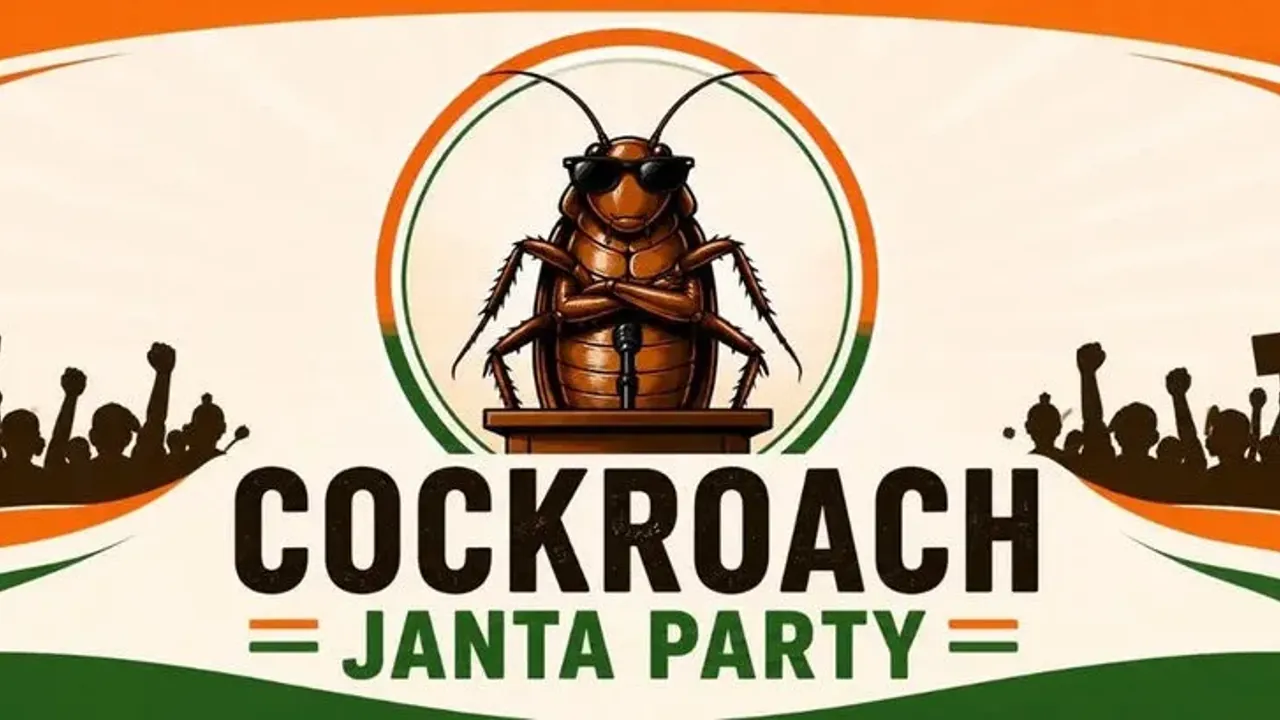
An insult from the top of India's judiciary has become the banner of a movement that now outranks the ruling party online. On Saturday, June 6, 2026, young Indians gathered at Jantar Mantar, the traditional protest ground in the heart of New Delhi, under an identity chosen to sting: the cockroach. They call themselves the Cockroach Janta Party (CJP), and their demand is single and blunt — the resignation of Union Education Minister Dharmendra Pradhan.
This is what sets the Indian case apart from the usual viral story. A label meant to demean was seized as a symbol of defiance, and an online joke grew into a political machine that has the establishment parties on edge. The question is no longer how clever the jibe is, but how deep the anger it channels runs.
From Courtroom to Hashtag
The name traces back to May 2026. In open court, Chief Justice of India Surya Kant compared some unemployed young people to cockroaches. "There are youngsters like cockroaches, who don't get any employment or have any place in the profession," he said, as quoted by Al Jazeera. In wider reporting, the remark was said to continue that some of them become media and social-media activists who then "attack everyone."
The response did not come as a lawsuit or a formal petition. Abhijeet Dipke, 30, posted a light question: "What if all cockroaches come together?" It spread fast, and within weeks a collective identity had formed out of an insult meant to crush.
Two things often blurred in early coverage are worth separating. Surya Kant's first comment was the trigger for the satire. After a fierce backlash, he issued a separate clarification, saying his target was people who obtain fake degrees, not India's young, whom he called "the pillars of a developed India." The clarification did not calm the movement. If anything, it gave CJP more fuel — proof, in the eyes of supporters, that the elite turn friendly only once caught out.
The Numbers Rattling the Ruling Party
CJP's growth on social media is the hardest part to dismiss. According to Al Jazeera's report on May 20, 2026, the group's Instagram account reached 11.1 million followers in just three days, overtaking the Bharatiya Janata Party (BJP) and its 8.8 million. The BJP is the ruling party and is often described as the largest political party in the world. In coverage on June 6, 2026, CJP's following was put at roughly 22 million, about double the BJP's.
What is moving here is not just a number but a signal. When a spontaneous movement with no party structure, no campaign budget, and no organizational machine outruns the government party's digital reach in so short a time, what shows is the size of the trust deficit among the young. Social media followers are not votes in a ballot box, and online euphoria often evaporates. But a gap this large, built this fast, points to a channel of anger that mainstream politics had failed to read.
The identity CJP chose is satirical and deliberately self-deprecating. Its membership criteria read: "unemployed, lazy, chronically online and people who can rant professionally." Its motto mocks constitutional slogans: "A political front of the youth, by the youth, for the youth. Secular – Socialist – Democratic – Lazy." This bitter humor is the glue, and also the shield that makes the movement hard to put down by conventional means.
The Roots: Exams, Degrees, and Jobs That Never Come
Behind the humor lies real, measurable despair. Al Jazeera cited data putting the unemployment rate among India's young graduates at 29.1 percent, about nine times the rate for those who never attended school, though the article did not name the source of the data. The figure inverts the old promise that education is the way out of poverty. In today's India, a degree can instead correlate with longer spells out of work.
The country's public higher-education system rests on high-stakes entrance exams that decide the futures of millions of teenagers each year, and it has long been dogged by recurring scandals, from leaked papers to technical failures to cancelled tests. Chaos in the national exams in early 2026, involving alleged paper leaks and digital-grading problems, became the final spark. For many students, the issue is no longer how hard it is to pass, but the conviction that the system itself is rigged.
That logic united protesters from different backgrounds. Mohammad Aftab, 28, a gig worker who joined the rally, explained why he came despite never having attended formal school. "I could not go to school, but there are millions of students who did not sleep at night for their exams, to make a life for themselves. It is our duty to stand up with them and demand that the criminal minister resign," he said.
A Leader Returned From Abroad
The figure at the head of the movement reflects a distinctly Gen-Z model of organizing. Abhijeet Dipke is a recent Boston University graduate in public relations who, according to a Bloomberg report on June 4, 2026, left India about two years ago to study before returning to Delhi to lead the protest. His diaspora background and his PR training explain part of how quickly the movement seized attention: he understands how online narratives work.
On the ground, Dipke pushed back on the idea that India's youth only perform on screens. "To everyone who believes that Indian youth only post on social media, come down here and see this," he said. He also insisted the movement would not fade after a single rally. "And to those who think we will go away after shouting, I want to say: we are cockroaches and we will stay until the minister resigns," he said — a deliberate nod to why the cockroach was chosen, for its connotation of being stubborn and hard to exterminate.
The History Lurking Behind a Word
Not everyone treats the wordplay lightly. The Wire warned of the historical danger of "cockroach" language, a term used in various chapters of history to dehumanize specific groups before violence against them was normalized. Seen that way, CJP's satire carries a second layer: it is not only a joke thrown back, but also a warning about the words a state and its elite choose when speaking of their youngest citizens. Reclaiming the word as an identity is a tactic of resistance, and a reminder of how dangerous the word becomes in the mouths of the powerful.
As of this report, the Indian government had not issued an official response to the June 6 protest. The size of the crowd also remains unclear. Al Jazeera and France24 described "hundreds" of participants, while The New York Times wrote "thousands," and organizers announced no firm figure. These reporting discrepancies could not be independently verified.
A Mirror for Indonesia
For readers at home, this is not a distant story. CJP is the latest chapter in a wave of Gen-Z protests that swept across Asia through 2024 and 2025, from Bangladesh and Sri Lanka to Nepal, with Indonesia itself hit by large demonstrations in the second half of 2025. The pattern repeats with a similarity too close to call coincidence: the economic anger of the young, organized through social media, then erupting into the streets at a speed that leaves established parties scrambling.
The concrete lesson lies in the mechanism. A single sentence from a senior official, tossed off with little thought, can become the pivot that unites grievances that were previously scattered. A frustrated young demographic does not wait for a party's permission or an institution's blessing to act; it turns channels of online entertainment into political infrastructure within days. What bears watching now is whether CJP survives as a street movement or hardens into a formal political entity, how the authorities respond on civil liberties, and whether India's momentum echoes back into the region's public square, Jakarta included. For policymakers anywhere, the signal is one: when hard work no longer tracks with opportunity, even cockroaches can march.