

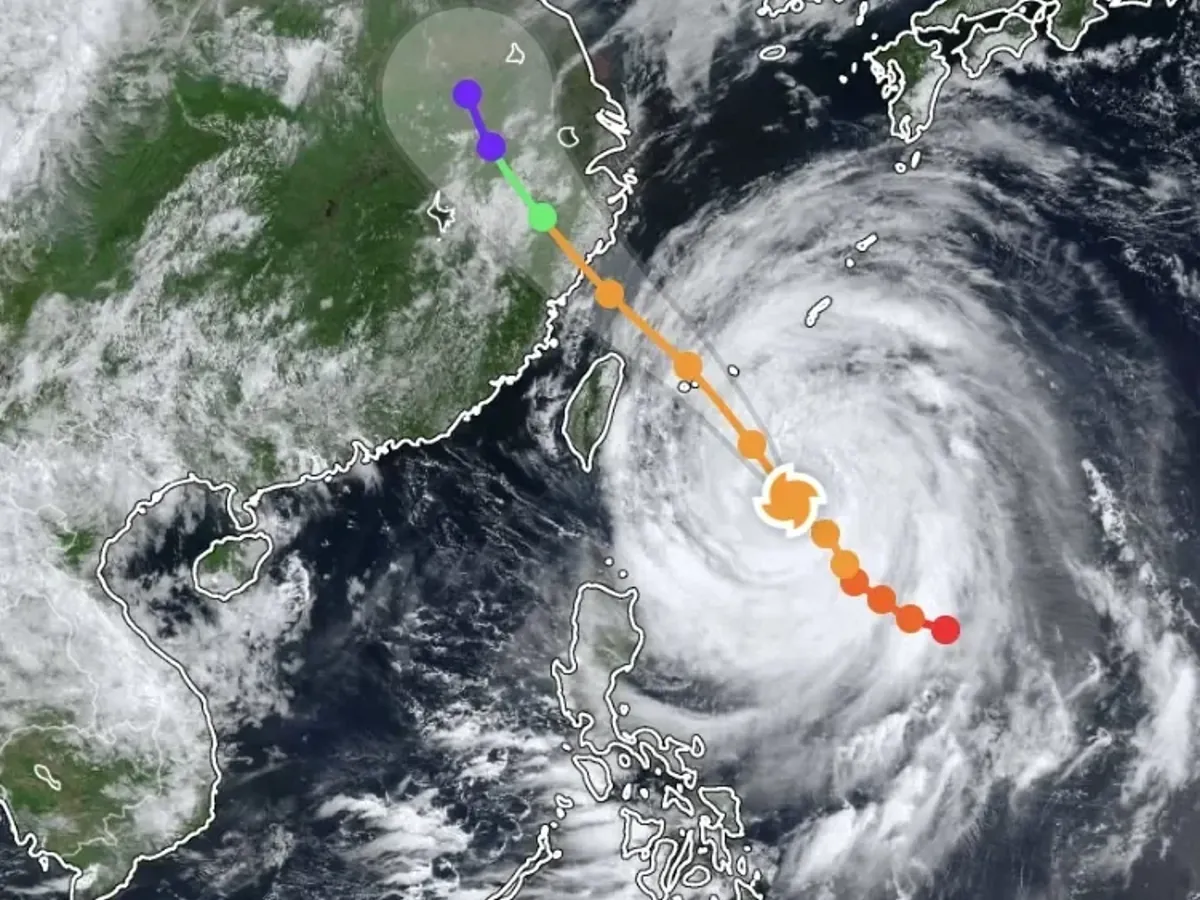
Typhoon Bavi made landfall twice on the coast of China's Zhejiang province on Saturday, first in the city of Yuhuan at 11:20 p.m. local time, then in Yueqing, part of Wenzhou, past midnight. China's Meteorological Administration downgraded it from a typhoon to a severe tropical storm on Sunday, but local authorities had already evacuated about 2.8 million people before the storm arrived.
Bavi formed as a low-pressure disturbance near Kwajalein in late June, then underwent rapid intensification, briefly matching Category 5 strength on the Saffir-Simpson scale as it crossed Rota in the Northern Mariana Islands in early July. Japan's Meteorological Agency recorded sustained winds of 205 km/h at the time, while the US Joint Typhoon Warning Center recorded 1-minute sustained winds of 285 km/h with a minimum pressure of 901 hPa, making Bavi the third Pacific typhoon to reach that intensity in 2026.
Mass evacuations ahead of landfall
Of the 2.8 million people evacuated, 2.2 million came from Zhejiang and more than 180,000 from Fujian province. In Yueqing, more than 1,300 trees fell, half of them uprooted at the roots, while roads in residential complexes flooded to half a tire's height.
The transport disruption spread to nearby major cities. Hangzhou's Xiaoshan Airport cancelled 327 flights, and the city's two main train stations halted service. Shanghai, farther from the landfall point, still cancelled 684 flights and more than 1,600 train trips as a precaution.
"We've been through typhoons before. We'll get through this one too," said Huang Xinghuan, a 50-year-old Wenzhou resident. Li Liangxing, a Yueqing resident, described the night of the second landfall: "We could hear roof tiles and tree branches falling."
As of Sunday, Chinese authorities had not reported any deaths from Bavi.
Why is the follow-up rain more dangerous than the typhoon's winds?
Bavi had already weakened to a tropical storm by the time it made landfall, but its rain is forecast to hit six provinces in northern and eastern China, Jilin, Liaoning, Hebei, Shandong, Jiangsu and Anhui, starting Monday. Some of the ground there is already saturated from Tropical Storm Maysak, which killed 39 people in southern China the week before, 26 of them in a partial dam breach in Hengzhou. That overlap between two rain systems in close succession is what raises flood risk once the wind dies down, a risk that was actually lower while Bavi was still a major typhoon.
"The rapid intensification of typhoons shortens preparation time for communities and emergency managers, making events like this especially challenging," said Benjamin Horton, dean of the School of Energy and Environment at City University of Hong Kong.
Bavi adds to a string of major disasters worldwide in 2026, from twin earthquakes that killed more than 1,400 people in Venezuela to a heatwave that killed 1,300 people in Europe in a single week.
A trail of damage before reaching China
Before hitting Zhejiang, Bavi first crippled Taiwan and struck Japan's southern islands on July 10 and 11. Its wind radius exceeded 1,000 km at sea, then narrowed to about 380 km as it approached Taiwan, still one of the largest typhoons to hit the island in decades.
In Taiwan, the fire department recorded at least 134 people injured as of 7 a.m. local time Sunday, and 14,210 residents were evacuated from mountainous and landslide-prone areas. In Japan, the storm struck Okinawa's Sakishima Islands, cutting power to more than 24,000 households and cancelling hundreds of flights.
The heaviest toll came further south. In the Philippines, heavy rain intensified by Bavi's circulation, known locally as Typhoon Inday, killed 18 people and left 14 missing, most of them in landslides on Mindanao, before the storm gradually weakened as it approached Taiwan and Japan.
Impact on Indonesian citizens in Taiwan
About 400,000 Indonesian citizens, mostly migrant workers, live in Taiwan, according to data from BP2MI (Indonesia's migrant worker protection agency) and the Indonesian Trade and Economic Office (KDEI) in Taipei. The evacuation of 14,210 people from Taiwan's mountainous and landslide-prone areas put some of them in the direct path of Bavi's impact, particularly workers living or working in areas hit by landslides and power outages.
What to watch
Attention now turns to whether the rain warnings for Jilin, Liaoning, Hebei, Shandong, Jiangsu and Anhui, in effect from Monday, materialize, and whether official casualty reports emerge from those provinces. KDEI Taipei also needs to track the safety of Indonesian citizens in the Taiwanese mountain areas that were evacuated, while the final injury toll in Taiwan and how quickly flight and train services recover in Shanghai and Hangzhou will show how fast the storm's economic impact fades.



Comments