
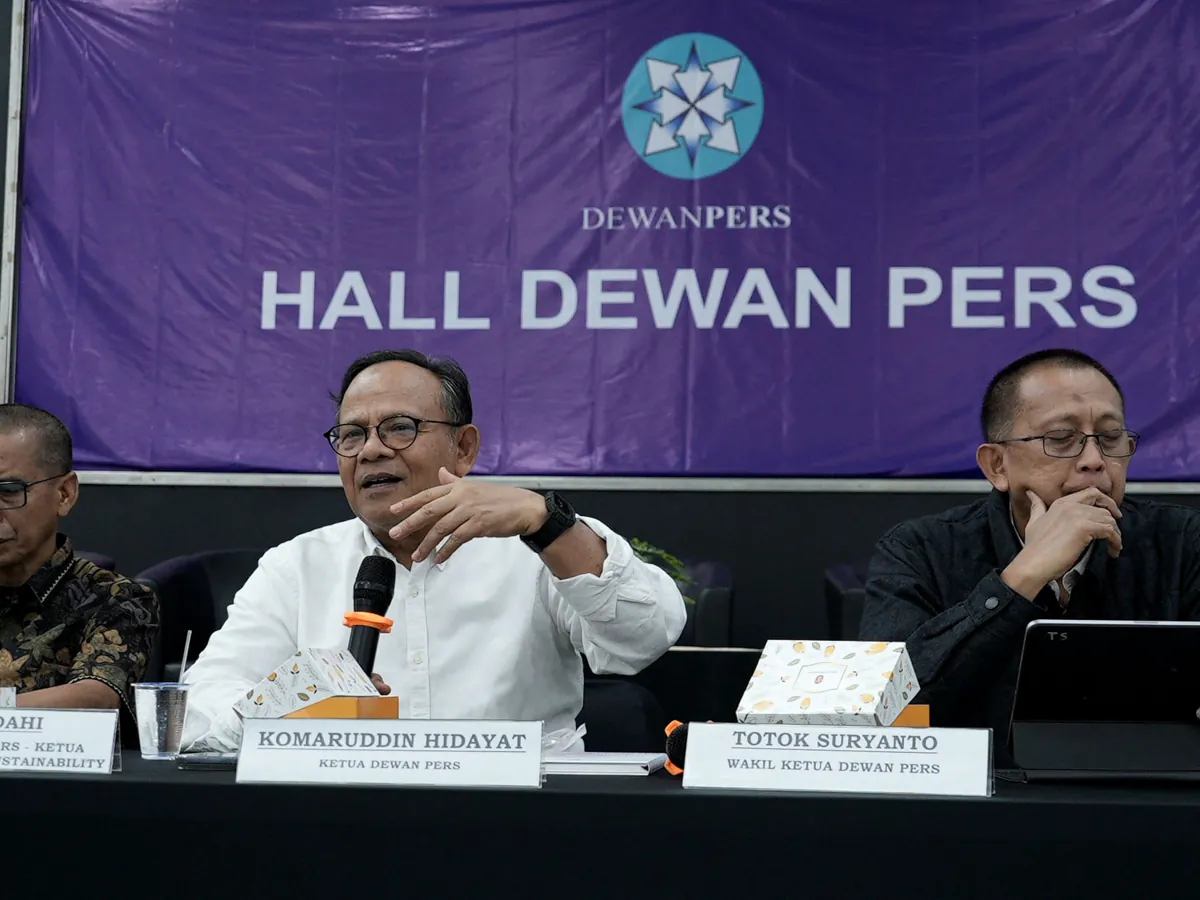
Digital platforms, search engines and artificial intelligence systems harvest the news every day to index it, excerpt it, aggregate it and feed it into model training. That activity generates enormous economic value, yet the news companies that produce the journalism receive almost no comparable compensation. It is that imbalance the Press Council (Dewan Pers) aims to address through a proposal to regulate journalistic work within the Copyright Bill (RUU Hak Cipta), gathering input at a public hearing with press constituents at the Press Council Hall in Jakarta on Thursday, June 11.
Journalism framed as an economic asset
The Press Council's core argument was blunt: news is not a free commodity. It maintained that journalistic work is the product of intellectual labor built through a chain of professional steps, from reporting and verification to processing information and publishing it for the public. Each stage demands cost, expertise and accountability — the same components widely recognized as sources of economic value in other intellectual works such as music, film and books.
From that premise, the Press Council concluded that journalistic work deserves legal protection on par with other creative works. The position matters because protection for journalistic output in Indonesia has rested largely on the Press Law, while its copyright dimension has lacked firm regulation. The hearing was, in essence, an effort to close that gap before the Copyright Bill moves into further deliberation.
Press Council Chair Komaruddin Hidayat placed the proposal within the survival of an industry under strain, calling the sector's staying power an asset that policy must support. "The resilience of our colleagues in the press industry is truly remarkable. Together we will work out how to adapt and what the solutions are amid this difficult situation. We hope protection for journalistic work in the Copyright Bill can be one of those solutions," he said.
A forum spanning almost the entire press spectrum
The makeup of the participants showed the forum was designed as a cross-organization consolidation rather than an internal discussion. Attendees included the Indonesian Journalists Association (PWI), the Alliance of Independent Journalists (AJI), the Press Companies Union (SPS), Indonesian Photojournalists (PFI) and the Indonesian Private Radio Broadcasters Association (PRSSNI). From broadcasting and cyber media came the Indonesian Local Television Association (ATVLI), the Indonesian Private Television Association (ATVSI), the Indonesian Cyber Media Association (AMSI), the Indonesian Cyber Media Network (JMSI) and the Indonesian Television Journalists Association (IJTI). The Press Legal Aid Institute (LBH Pers) and the Committee on Digital Platform Companies' Responsibility for Supporting Quality Journalism (KTP2JB) rounded out the list.
Bringing together journalists' organizations, press companies, photojournalists and a legal aid body signaled that the question of economic rights over journalistic work touches the entire news production chain, from the individual reporter to the business that publishes the story. Consolidation of this kind is a precondition for any proposal carried to the government and parliament to carry broad representative weight.
Three ideas forming the backbone of the proposal
Discussion in the forum narrowed to three points that drew wide attention from participants. First, the need for explicit recognition of journalistic work as a protected object under the Copyright Law. Without that clear recognition, downstream demands over economic rights would lose their legal footing.
Second, the need to recognize the economic rights of press companies over the journalistic work they produce and publish. This point shifts the focus from a creator's moral rights to the economic rights of the business that bears the cost of producing the news. Third, the need for clearer rules on the use of journalistic work by digital platforms, news aggregators, search engines and artificial intelligence systems.
The three points interlock: recognition as a protected object is the foundation, the economic rights of press companies are the substance, and rules on platform use are the enforcement mechanism. That logical sequence is what will be tested once the proposal reaches the lawmakers' desk.
Value flows to platforms, compensation does not follow
The heart of the problem participants highlighted lies in the widening use of journalistic work without proportional payment. News is now used for indexing, aggregating information, displaying excerpts and training AI models. These practices were seen as creating economic value for various parties without any matching mechanism to compensate press companies and the creators of journalistic work.
For Indonesian readers, the practical implications are real. As traffic and advertising revenue shift to platforms that display news snippets, the newsrooms that fund the reporting lose their revenue base. The AI era deepens the imbalance: AI models can absorb years of journalistic work to produce instant summaries, with no trail of compensation back to the original source. Left unchecked, economic pressure on newsrooms risks eroding the quality and quantity of reporting the public has a right to access.
A collective body to rebalance bargaining power
To address that imbalance, the forum discussed the possible creation of a collective mechanism, a Collective Management Organization (LMK), tasked with managing licensing and distributing the economic value generated by the use of journalistic work. A similar scheme already exists in the music sector, where collective bodies collect and distribute royalties on behalf of many creators at once.
Several participants saw the mechanism as an important tool to strengthen the bargaining position of the national press industry. The logic rests on collective action: a single press company struggles to negotiate rates with global platforms or giant AI developers, but a coalition of many publishers under one licensing body wields far greater leverage. An LMK, in this framing, serves to offset the power asymmetry between the domestic press industry and cross-border technology corporations.
Drawing the line: regulate the commercial, protect public access
The Press Council sought to head off the misreadings that surface whenever copyright regulation is debated. It stressed that the proposed protection for journalistic work is not meant to restrict freedom of expression, public access to information or technological progress. Instead, the rules are aimed at creating an information ecosystem that is healthy, sustainable and fair for everyone involved.
Press Council Deputy Chair Totok Suryanto tied the industry's interest to the public's. "Protecting journalistic work ultimately safeguards not only press companies and journalists, but also the public's right to obtain quality, trustworthy information," he said.
The limits of the scheme were also clarified by type of use. Press Council member and Chair of its Digital & Sustainability Commission, Dahlan Dahi, said the protection targets only commercial use, while non-commercial use remains permitted. "For instance, if journalistic work is used for education, research or academic study," he added. The clarification marks the scheme as aimed at those who profit economically from the news, not the teachers, researchers or students who use it for scholarship.
The ball moves to the government and parliament
All the input raised at the hearing will feed into refining the Press Council's proposal to the government and parliament during deliberation of the Copyright Bill. In other words, the consolidation of press constituents has cleared only one stage; the real test will play out in the legislative arena, where the proposal must compete with the interests of digital platforms and the political dynamics of drafting a law.
Several key questions still hang over the proposal and will decide its fate: how far the economic rights of press companies will be spelled out operationally in the bill's articles, whether a Collective Management Organization for journalistic work is actually adopted, and how the definition of "commercial use" is bounded so it does not become open to interpretation when confronting artificial intelligence systems. The answers to those three questions will show whether protection for journalistic work stops at the level of discourse or becomes a binding norm.