
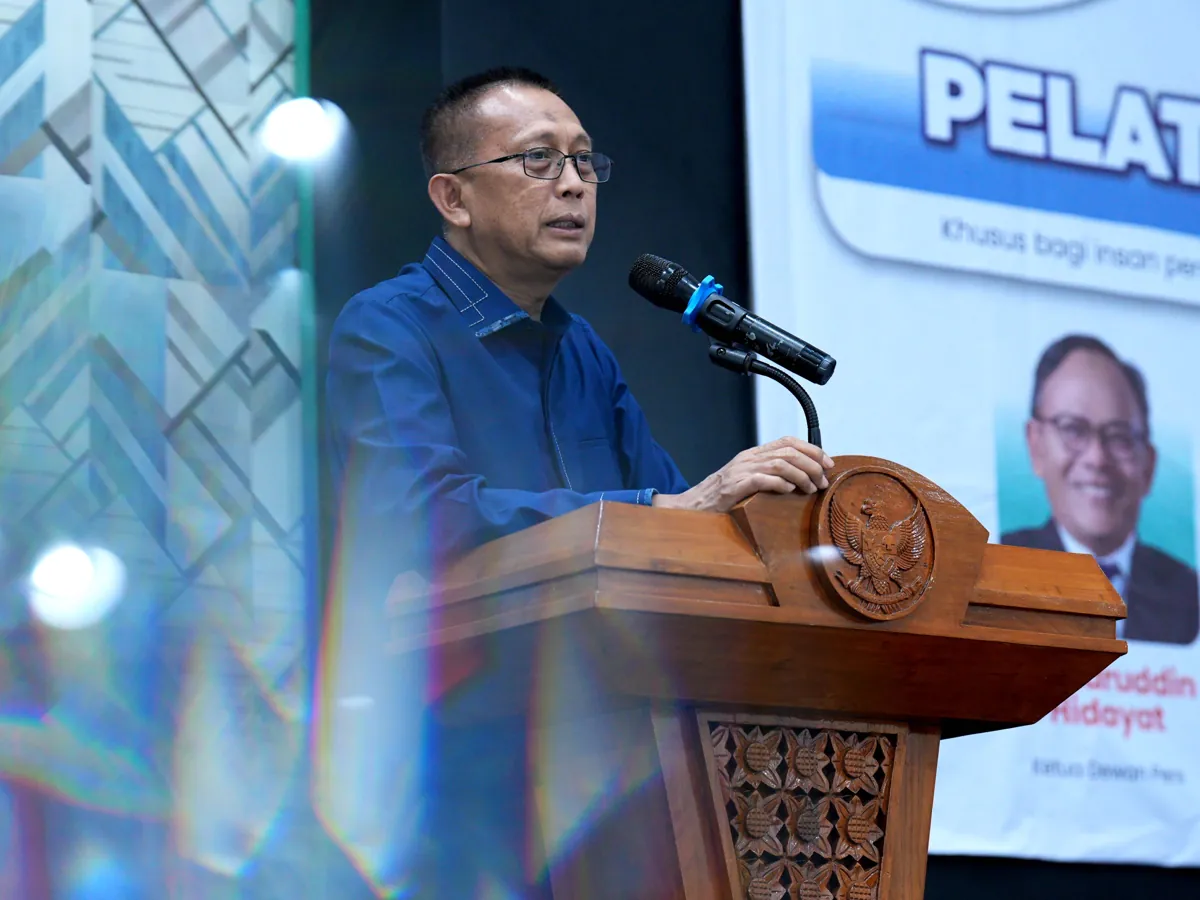
Indonesia's Press Council held a training workshop Tuesday on artificial intelligence for creative news production, drawing 176 journalists from across the country interested in improving productivity and exploring new revenue opportunities.
The workshop, held at Press Council headquarters in Jakarta, featured the Createwhiz team as instructors and attracted 40 in-person participants and 136 online attendees from news outlets across Indonesia.
Totok Suryanto, deputy chair of the Press Council, said AI should enhance human potential by enabling deeper, more strategic, and more imaginative thinking.
"Journalists must understand AI as a tool to improve the quality of their work, expand their reach, and create new economic opportunities," he said. He added that "AI is inevitable and we must master it. But don't use AI merely to complete tasks without ensuring you're using your full human capacity to think. Creativity is key to how we manage and use AI as a tool."
Dahlan Dahi, a board member and chair of the Press Council's Digital and Sustainability Commission, echoed the message: "AI should be a tool that helps humanity, not harms it."
The Press Council organized the training in response to AI's growing role in journalism. Many journalists have not yet fully adopted AI because they lack understanding of how to work effectively with the technology.
"This initiative helps media workers adapt to AI technology to boost productivity, creativity, and diversify revenue streams," Dahi said.
The Press Council issued Regulation No. 1 of 2025 on the use of artificial intelligence in journalism. Rosarita Niken Widiastuti, a board member and vice chair of the Digital and Sustainability Commission, reminded journalists to follow the guidelines.
"The regulation requires humans to remain involved throughout the journalism process from start to finish," Widiastuti said. "It also addresses the integrity of AI use because AI data may not be accurate. AI data comes from various sources. Journalists have always fed AI with accurate information, and we must continue following these guidelines."
What the training covered
Participants learned how AI has changed the creative production process, from idea development and visual design to generative video production. Through hands-on exercises, they studied prompting techniques, strategy formulation, and creative production simulation, along with various AI tools to increase productivity.
The Createwhiz team showed how AI can accelerate production and expand creative scope while preserving the human judgment essential to creative work.
Monetizing AI-enhanced journalism
The workshop also featured a panel discussion on monetizing AI-powered creative products. Participants examined case studies and real-world examples showing how AI-assisted work creates new revenue streams.
Utami Fitriyani, digital marketing lead for MWX Indonesia, said journalists possess something AI lacks: human perspective, audience trust, and storytelling ability built from years of experience. AI-powered content production can help scale output and diversify revenue.
"The real differentiator isn't just the visual quality of AI output," Fitriyani said. "It's how relevant that content is to your audience's needs in that moment. That's where journalists' creativity and skill are essential. AI isn't a threat; it can boost productivity and diversify revenue streams for journalists. The best time to start monetizing your AI-enhanced journalism was yesterday. The second best time is today."
The Press Council's ongoing commitment
The Press Council plans to conduct regular AI training for media outlets, with the aim of helping news organizations use AI more strategically to strengthen competitiveness, ensure business sustainability, and produce relevant creative content in the digital age.