
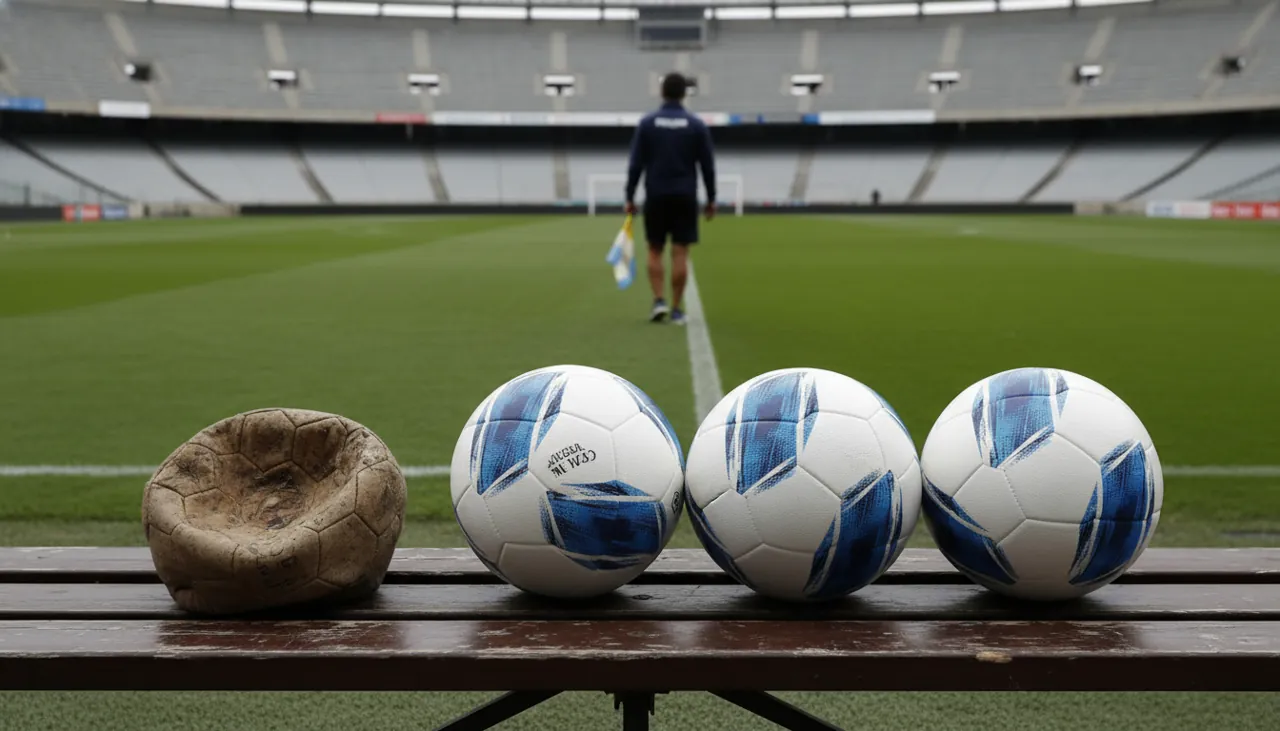
The 2-0 win over Honduras at Kyle Field in College Station, in the early hours of Sunday (June 7, 2026) Jakarta time, said little on its own. Argentina's bench said more. Lionel Messi watched from the sideline with muscle fatigue in his left hamstring, first-choice goalkeeper Emiliano "Dibu" Martínez was out with a broken ring finger, and Julián Álvarez did not start. La Albiceleste won anyway, through a Lautaro Martínez penalty in the 36th minute and a Giuliano Simeone goal in the 54th, but the last tune-up before the tournament posed a question far bigger than the scoreline: are the defending champions ready to live without three of their pillars?
A win that wasn't the story
Honduras offered no serious yardstick. The Central American side failed to reach the 2026 World Cup after a goalless draw with Costa Rica in their decisive qualifier, so the match in Texas served more as a rhythm test than a test of quality. Argentina dominated from the start with 71 percent possession in the first half, and the result extended their run to five straight unbeaten friendlies heading into the tournament.
The more interesting read was the side Lionel Scaloni put out: Musso in goal; Giay, Otamendi, Lisandro Martínez and Tagliafico in defense; Giuliano Simeone, Palacios and Valentín Barco in midfield; Lo Celso as the link; and Thiago Almada and Lautaro Martínez up front. Veterans of 2022 lined up alongside two 21-year-olds in Giay and Barco. This was the blend Scaloni wanted to test, not to beat Honduras but to see how much weight the second tier could carry while the stars sat out.
The match was the first of two final warm-ups. After Honduras, Argentina face Iceland in a few days, before opening their title defense against Algeria on June 16 in Kansas City. Group J also features Jordan, a World Cup debutant, and Austria, back at the tournament for the first time since 1998.
The retention numbers people keep mixing up
One point of confusion is worth clearing up here. Two figures are circulating for how many of the 2022 champions Scaloni brought back, and both are correct because they measure different things. ESPN counts 17 of the 26 names in the 2026 squad as members of the Qatar-winning team. That figure includes goalkeepers. World Soccer Talk uses a tighter measure: 15 outfield players retained, and by that measure Argentina top every defending champion this century.
The distinction matters because the comparison is about outfield players, the positions worn down fastest by age and the demands of competition. For context, Spain took 14 outfield champions to 2014 and went out in the group stage. Italy took only eight in 2010 and exited early, as did Germany with eight in 2018. France took the opposite path, retaining only seven outfield champions from 2018 into 2022, yet that team reached the final. Set side by side, the pattern is unwelcome for those who believe in squad loyalty: there is no clear link between holding on to many former champions and successfully defending the title. The side that kept the most, Spain, suffered the most embarrassing exit.
The historical record is harsher still. No team has retained the World Cup since Brazil in 1962. France in 1998, Italy in 2006, Spain in 2010 and Germany in 2014 all fell at the same hurdle. Argentina now aim to break through with the statistically most conservative approach of any of the failed predecessors.
Scaloni's philosophy: loyalty or a time bomb
Scaloni's boldest call was not who played against Honduras but who was cut. Franco Mastantuono, the wonderkid who moved to Real Madrid in 2025, did not make the 26. Bournemouth defender Marcos Senesi and Aston Villa attacking midfielder Emiliano Buendía were also left out. Dropping Mastantuono was the biggest surprise, and it reads like a statement of philosophy: Scaloni chose the certainty of proven winners over potential that has yet to be tested at the highest level.
That choice made sense until the injuries spoke. Before the tournament had even begun, two of the most important pillars were already in doubt. Messi, who turns 38 at this World Cup, is being managed with extra care. Dibu Martínez, the goalkeeper who became the hero of the 2022 final shootout, is hurt. The spine kept for its experience also carries the physical fragility that comes with age, and it showed even before the first competitive match.
That is the risk hanging over the whole campaign. Keeping many champions preserves cohesion, automatisms and a winning mentality that are hard to rebuild. But it also piles minutes onto legs past their peak, at a tournament expanded to 48 teams for the first time, with a denser schedule. Lautaro Martínez, now on 36 international goals and the top scorer at the 2024 Copa América, is the bright side of that continuity. The question is whether an aging midfield and defense can hold up to the knockout rounds at the same tempo.
What Scaloni says about Messi
Scaloni struck a calm note about his captain's condition. "He has progressed well, to the point where he could take part in the two friendlies (Honduras and Iceland) for a few minutes. We will assess whether that happens tomorrow against Honduras or in the next match, but he feels much better, and that gives us enormous peace of mind," the Argentine coach said, as reported by Metro TV.
Even so, the tone stayed cautious. On the assessment of Messi's hamstring injury, Scaloni held back from any certainty. "Obviously we would have preferred that nothing had happened. Now one has to wait and see how it evolves and above all the new tests they are going to conduct in order to see if it confirms their original diagnosis," he told DSports. Optimism and caution sit side by side: the captain is improving, but the final decision waits on further tests.
The situation with Dibu Martínez is more open still. The broken ring finger leaves the first-choice goalkeeper in doubt, so the position for the opener against Algeria is not yet settled, with Musso and Gerónimo Rulli as options if Dibu has not recovered.
Beyond fitness, World Soccer Talk's analysis questions whether the dose of renewal in this squad is enough to break the defending champions' curse, precisely because Argentina carry the most outfield champions of any predecessor this century. That assessment frames the win over Honduras correctly: not proof of readiness, but practice at patching holes that will gape if Messi or Dibu are out for longer.
The Indonesian angle: big audience, thin coverage
For fans at home, the 2026 World Cup carries a meaning of its own. Indonesia has one of the largest Argentina and Messi fan bases in the world, an enthusiasm that boiled over when the Argentine national team hosted Indonesia in Jakarta in June 2023. This tournament is most likely the last chance to see Messi on a World Cup stage. The 2026 edition is also his sixth appearance, a record of six World Cups he now shares with Cristiano Ronaldo and Mexico goalkeeper Guillermo Ochoa.
But there is a gap between the size of local demand and the availability of coverage. The match against Honduras was reportedly not broadcast live by national television or any official streaming platform in Indonesia, according to Suara Merdeka, forcing fans to hunt for alternative feeds in a weekend pre-dawn slot. The contrast feels odd given that the tournament itself is set to air free on TVRI. For non-tournament games like this warm-up, a large audience does not guarantee adequate broadcast rights, and that is a real consumer issue ahead of kickoff.
What to watch
A few markers will say more than the result against Honduras. First, Messi's minutes against Iceland. Scaloni signaled his captain could play "a few minutes" in one of the friendlies, and whether that comes against Iceland will be the most important fitness indicator before June 16. Second, certainty over the goalkeeping position after Dibu Martínez's injury. Third, the showings of the second tier, players like Barco, Giay, Giuliano Simeone and Nico Paz, who will determine how deep a rotation Scaloni can rely on in a 48-team format.
The real test of this whole bet on loyalty to the winners only arrives against Algeria. Until then, this win without Messi, Dibu and Álvarez is better read as a dress rehearsal for succession than a guarantee that the defending champions' curse will break in Argentina's hands.