
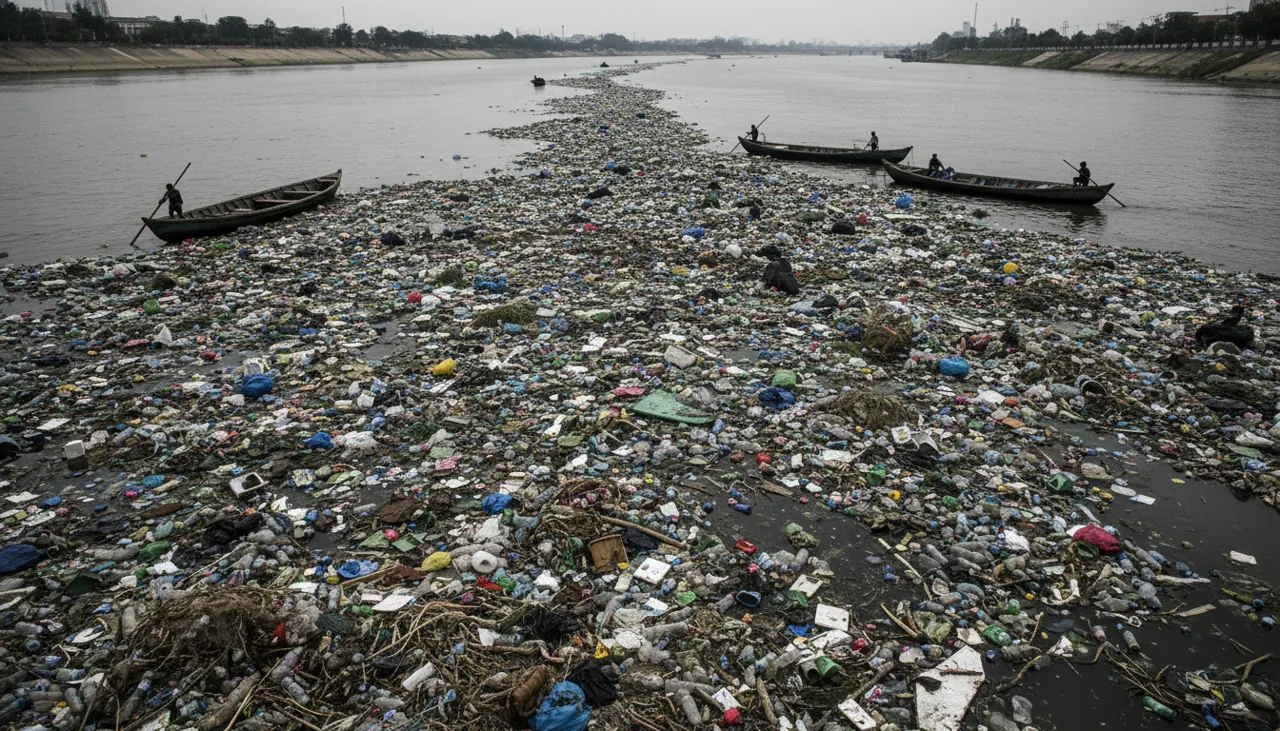
For four days, about 70 joint personnel clawed at a mass of waste that had clumped into a small landmass along the shore at Muara Kali Adem in Penjaringan, North Jakarta. They hauled out 8.8 tons. Yet the daily totals climbed rather than fell: 0.88 tons on the first day, surging to 3.52 tons on the third, before easing to 2.64 tons on the last day, June 5, 2026. The pattern hints at something uncomfortable. The sediment at the river mouth does not merely hold back the waste visible on the surface; it keeps disgorging more from within the mud. The cleanup finished what could be seen, not what keeps flowing in.
That is the heart of the Muara Angke "garbage island" that went viral on Thursday, June 4, 2026. The pile, stretching across a band of sediment roughly 600 to 700 meters from the shoreline, was dominated by plastic, kitchen-product packaging, and chunks of wood blended into dark, foul-smelling mud. The Jakarta provincial government worked the site from June 2 to 5, 2026. But reading the episode as a tidy sanitation incident, closed out at 8.8 tons removed, misses the main point: the island is a collection point, not a source.
Trapped by sediment, not a dirty sea
Jakarta Governor Pramono Anung described the phenomenon as a product of sedimentation. Waste washes down the rivers from upstream, snags on the silt that builds up at the river mouth, then piles up and congeals under the push of sea waves. "As for what happened at Muara Angke, the garbage island formed because of sedimentation," Pramono said. Heavy rainfall in the preceding months, going back to February, swelled the volume of waste drifting into northern Jakarta.
That technical account actually points far from the coast. At the river mouth, the current slows and particles settle out. The mud that forms there acts like a trap, holding land-borne waste until it congeals into something resembling an island. In other words, the sea only receives what the rivers send it.
Officials in the field refuse to cast the sea as the culprit. "Where does the garbage come from? The sea is actually clean. It all flows from the land," said Supendi, coastal supervisor at the Thousand Islands branch of the city environmental agency (Sudin LH Kepulauan Seribu). The remark is plain, but it puts the focus in the right place. Muara Angke's problem begins in the city's gutters and rivers, not on the coast.
Why the 8.8-ton figure can mislead
The "8.8 tons" headline is easy to read as the measure of a problem already solved. That reading is wrong. The figure is the output of a four-day operation, not the total waste load sitting in the sediment zone. It is the trend in daily tonnage that deserves a closer look.
"Results of the waste handling at the Muara Kali Adem sediment site: 0.88 tons on day one, 1.76 tons on day two, 3.52 tons on day three, and 2.64 tons on day four," said Lukman Dermanto, head of the waste and hazardous-waste handling section at Sudin LH Kepulauan Seribu.
The rise from the first day to the third could mean two very different things. The team may simply have grown better at reaching the inner core of the pile. But it could also be that the sediment holds far more waste than is visible, so the more they dig, the more emerges. If the second reading holds, the four-day cleanup touched only a part of it, and the area is liable to throw up a similar island the next time heavy rain arrives. This is not a forecast but a logical consequence of the mechanism the official himself described.
Officials on the ground do not hide that this is a recurring problem. "The biggest challenge, for sure, is the garbage that is always there. It always comes from upstream," said Afan Adriansyah Idris, assistant for development and the environment to the Jakarta regional secretary. The phrase "always comes" is an admission that the hauling operation treats only the symptom for as long as the tap upstream stays open.
The structural pressure pushing from land
The Muara Angke garbage island sits atop a strain far larger than any single river mouth. Jakarta produces roughly 7,300 to 8,000 tons of waste a day. Its final destination, the Bantargebang integrated waste-treatment site (TPST Bantargebang), is already more than 80 percent of the way to its 70-million-ton capacity and even suffered a landslide in March 2026. When the final dumping ground is critical and sorting at the source has yet to show meaningful results, the room for waste to leak into waterways grows wide. Some of what cannot be contained or sorted on land flows down the rivers, and the river mouth is the last stop before the sea.
Seen that way, Muara Angke is no anomaly. It is the most visible end of a capital-city waste chain that has not been brought under control. As long as upstream volumes are not cut and river management is not tightened with filters and trash nets, the river mouth will keep serving as an open dump. Cleaning the coast without touching the upstream is like mopping the floor while leaving the tap running.
Field capacity is also limited. Equipment broke down around February to March, and personnel are stretched thin, with about 50 officers covering a broad coast that runs from Kamal to Cilincing. Under those constraints, the response to a garbage island tends to be reactive, moving in after a pile goes viral rather than preventing it from forming.
What fishermen feel first
For residents, the impact is anything but abstract. Muara Angke is one of Jakarta's largest small-scale fishing hubs, and the waste mixed into the mud disrupts boat traffic. "Coming in and out, the fishermen's boats run aground at low tide. And the propellers often snap," said Syahril, 55, a Muara Angke fisherman. Replacing a broken propeller reportedly costs around Rp100,000 a unit, no small burden on a thin daily income.
The losses spread to the quality of the catch. A fishermen's coordinator named Sini said fish that cannot be unloaded on time lose their freshness and drop a grade, and the value of a single haul can reportedly plunge from around Rp15 million to Rp17 million down to about Rp4 million to Rp5 million. These figures should be read with caution, as they come from the account of a single fisherman and have not been verified against official cooperative or fish-auction data. Still, the direction of the impact is consistent with other complaints on the ground: when boats run aground and unloading is delayed, the biggest loss is not the visible garbage but the fish rotting as they wait their turn.
The irony of the coastal plan
The problem surfaces just as the provincial government is floating a plan to use sediment from more than a dozen rivers to build a waste-processing island in the bay, a proposal it says will be studied together with academics and environmental activists. Here lies the irony. River-mouth sedimentation, the very mechanism that traps waste and builds an island at Muara Angke, would become the basis for a large-scale coastal project.
The relevant question is not one of intent but of management. If the natural sediment of a single river mouth can already trap waste until it congeals into a small landmass, how does one ensure that a man-made island built from sediment will not repeat the same problem on a larger scale? The Muara Angke case offers early data that any study of the project cannot afford to ignore.
What will decide what comes next
The real test is not the 8.8 tons already hauled away but whether the garbage island reappears in the coming weeks, especially when the rain returns. A reappearance would be proof that the response stopped at the symptom. Steps that reach the root, by contrast, would show up upstream: more filters and trash nets in the rivers, stronger sorting at the source, and repairs and reinforcements for the equipment and staffing that officials themselves called broken and short.
The decisive backdrop remains the status of Bantargebang and the final capacity of Jakarta's waste disposal. As long as the pressure upstream does not ease, the river mouth will keep absorbing the overflow. The Muara Angke garbage island, in the final count, is not a story about a dirty coast. It is about a city that has yet to close its own waste tap.