

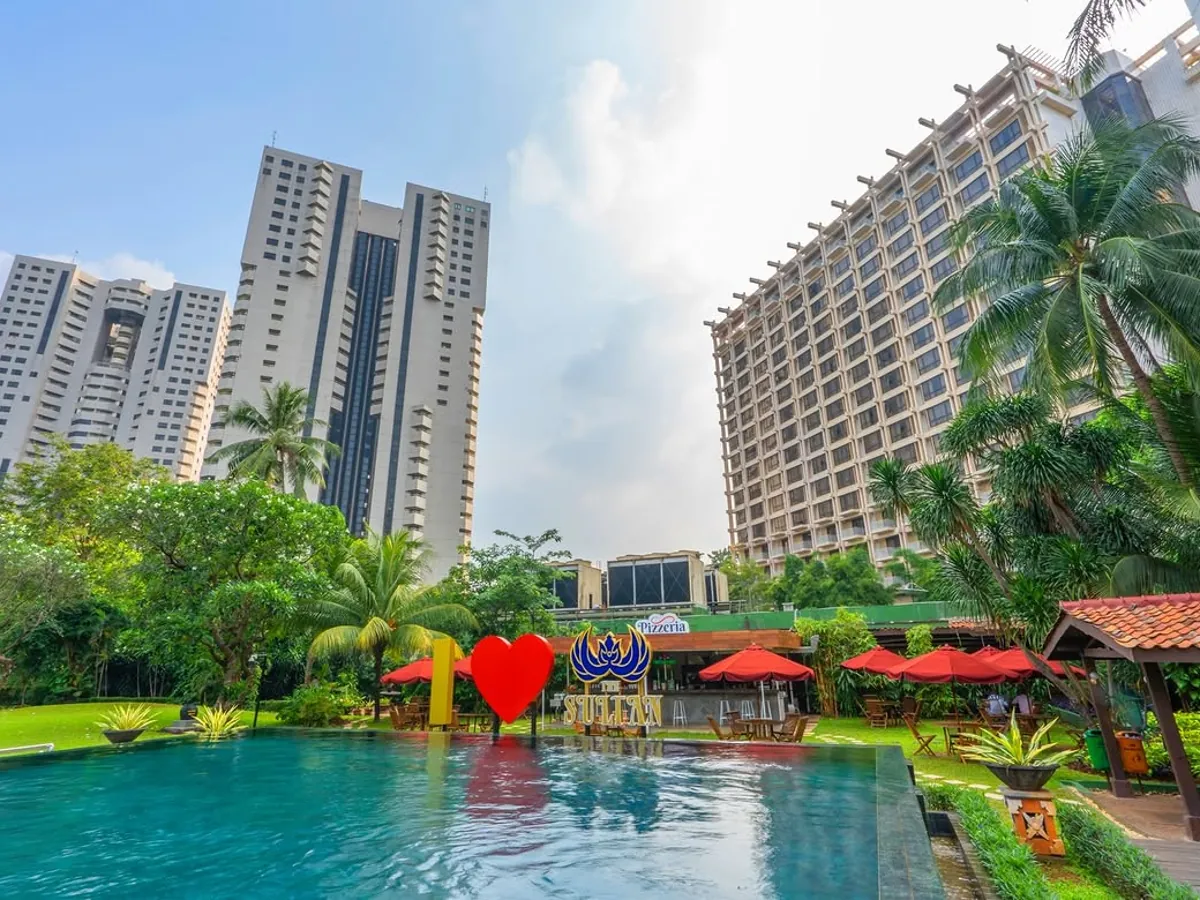
Three weeks after Indonesia seized Hotel Sultan's land from PT Indobuildco on June 18, 2026, a new claimant stepped forward with a Rp14.5 trillion lawsuit arguing that neither the state nor the company ever had rightful title to the property.
RM Kusrahardjo, who says he is a descendant of Pakubuwono VIII, the king of Solo, is suing six defendants at once: Indobuildco, the Ministry of State Secretariat, the Ministry of Finance, the Ministry of Agrarian Affairs and Spatial Planning/National Land Agency (ATR/BPN), the head of the Central Jakarta Land Office, and the GBK Complex Management Center (PPKGBK). He accuses all of them of unlawful acts against land he says his ancestors owned.
His claim rests on Eigendom Verponding No. 1684, a Dutch colonial land title that, according to the plaintiff, was issued in 1938 in the name of RM Koesno over roughly 420,500 square meters in the Senayan area. Eigendom verponding was a colonial-era land right that, after Indonesia's Basic Agrarian Law (UUPA) No. 5/1960 took effect, had to be converted into the national land title system. Kusrahardjo's attorney, Suryadi, says RM Koesno was Pakubuwono VIII and that the document was recorded by the Directorate General of Agraria in January 1980. "That is Pakubuwono the Eighth, or the Eighth King of Solo," Suryadi said.
Who are the defendants and how much are they facing?
The lawsuit is registered as case No. 411/Pdt.G/2026/PN Jkt.Pst and classified as an unlawful act. The six defendants face a combined material claim of Rp14.5 trillion plus Rp500 billion in immaterial damages. Kusrahardjo is also asking the court to annul Building Use Rights (HGB) No. 26 and No. 27, the two certificates that underpinned Indobuildco's legal hold over the hotel site for decades.
The first hearing, on July 1, 2026, was adjourned immediately. Suryadi explained afterward: "It was postponed because it wasn't complete. All defendant parties had been summoned and received notice, including the Minister of Finance, ATR/BPN, GBK, and the State Secretariat, except for PT Indobuildco." The hearing continued on July 8, 2026.
Why is this claim only surfacing now?
The state's attorneys raised that question directly. "And it naturally becomes a question for the plaintiff too: why only now? Where have you been all this time?" said Kharis Sucipto, attorney for PPKGBK and the State Secretariat, after the July 8 hearing.
Kusrahardjo's lawsuit was absent throughout the main conflict between the state and Indobuildco, which ran for more than two decades. During that period, several final and binding rulings affirmed Land Management Right (HPL) No. 1 Gelora as the valid legal basis for state control over the land. Kharis says those rulings are final and binding. Now, precisely as the asset transfer is complete on paper, a third party has appeared claiming neither side was ever entitled to the land.
That puts Kusrahardjo in an unusual position: one lawsuit targeting both the party that just won and the party that just lost in the same case.
What weakens the 1938 document?
The authenticity and legal status of Eigendom Verponding No. 1684 is the most critical point of proof in this case. UUPA 1960 gave holders of colonial-era land rights, including eigendom titles, 20 years to convert them into the national system. That deadline fell on September 24, 1980. Rights not converted in time are treated as having reverted to state control.
The plaintiff claims the document was registered with the Directorate General of Agraria in January 1980, nine months before the deadline. But the state's attorneys dispute the document's existence at the contested site. "There is no Eigendom Verponding 1684 registered on the land of the former HGB 26 and the former HGB 27," Kharis Sucipto said.
Suryadi held his position: "This matter is between the heirs of the landowner and Eigendom Verponding document number 1684 in the name of RM Koesno."
If the defendants' objection successfully attacks the document's existence at the outset, the case could be dismissed before reaching the merits. If the panel decides the ownership claim warrants deeper examination, the dispute could enter a lengthy evidentiary phase, with the authenticity of the 1938 document at stake.
Hotel Sultan: background on the dispute
Hotel Sultan, known in its early years as the Hilton Jakarta, was built in the early 1970s to host an Asia-Pacific tourism conference. PT Indobuildco, a company linked to the family of Ibnu Sutowo, former head of state oil company Pertamina, obtained HGB titles from 1972 to 1973 for 30 years. Subsequent extensions triggered conflict: the government concluded Indobuildco had not met its obligations, including royalty payments for use of state assets.
Indobuildco's HGB expired in 2023, and the dispute ended in an execution on June 18, 2026, based on ruling No. 208/Pdt.G/2025/PN Jkt.Pst. The company was ordered to vacate and pay around Rp751 billion in back royalties. GBK Block 15 formally transferred to PPKGBK's management.
Indobuildco, which had not received its summons for the first hearing, has issued no public statement on Kusrahardjo's lawsuit. It now sits as a defendant in two separate disputes over the same land.
What will determine the case's direction
Hearings after July 8, 2026 will test two things: whether the state's preliminary objection over the absence of an eigendom document at that location will be accepted by the panel, and whether Indobuildco will appear to state its formal position.
If the case proceeds to the merits, the authenticity of Eigendom Verponding No. 1684 and the January 1980 registration record at the Directorate General of Agraria will need to be proven through original documents. The final ruling could become a reference for similar claims based on colonial-era land titles over unresolved strategic state assets.
Comments