
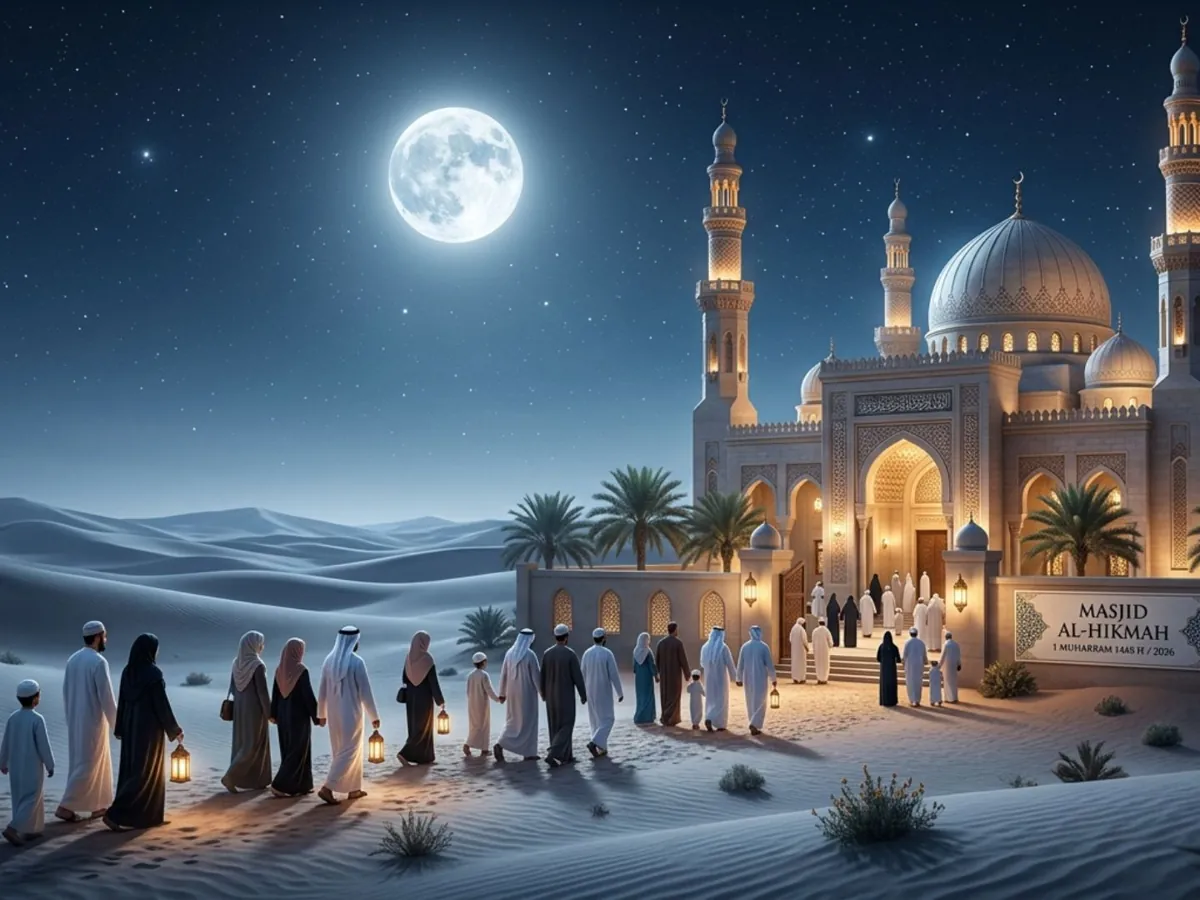
Indonesia's national holiday for the Islamic new year falls on Tuesday, June 16, but the traditionalist Nahdlatul Ulama is marking 1 Muharram 1448 H on Wednesday, June 17. The rare split stems from conflicting interpretations of crescent visibility data.
Why the Dates Differ
Such disagreement is uncommon for the Islamic new year, which typically sees broader consensus than contentious calendar determinations like Eid. The split traces to crescent moon observations on June 15. The Religious Affairs Ministry recorded a crescent height ranging from 0.92 degrees at Merauke to 4.02 degrees at Sabang, with elongation between 5.64 and 6.98 degrees—measurements that sat precisely at the boundary of MABIMS criteria, an inter-Islamic standard requiring a minimum height of 3 degrees and elongation of 6.4 degrees.
Nahdlatul Ulama's Falakiyah Council, the organization's astronomical authority, relies on direct moon sighting—observers stationed across Indonesia searching for the crescent at dusk. "All locations failed to observe the crescent," according to an official letter dated June 15 from the council's chairman, KH Sirril Wafa, and secretary, H Asmui Mansur. With no crescent observed, the council completed the previous lunar month at 30 days, setting the Islamic new year for Wednesday, June 17.
The Religious Affairs Ministry uses a different approach, combining calculation with sighting criteria. Arsad Hidayat, the ministry's director of Islamic affairs, explained: "Using those parameters, most regions of Indonesia met the MABIMS minimum criteria, placing the start of Muharram 1448 H on Tuesday, June 16." Muhammadiyah, using a calculation method based on the crescent's theoretical position, reached the same conclusion. The conjunction—the moment the sun and moon align—occurred at 9:55 a.m. on June 15, making the crescent relatively young at sunset, a factor that positioned it squarely in the gray zone between the two methodologies.
The government affirmed it respects the difference. "We respect NU's decision," said Thobib Al Asyhar, head of the Religious Affairs Ministry's communications bureau.
Impact on Communities and Observance
The most concrete consequence is scheduling. The government has declared a national holiday on Tuesday, June 16, but Nahdlatul Ulama members will mark their new year on Wednesday, June 17. Year-end prayers and new-year rituals—traditionally observed on the eve of the calendar change—will fall on different nights depending on one's affiliation: Tuesday for government and Muhammadiyah followers, Wednesday for NU members.
The one-day offset will also affect Ashura, the 10th of Muharram, and optional Muharram fasting, shifting these observances by a day between the two communities. Pesantrens and Islamic boarding schools aligned with each organization will likely follow their respective calendars, a divergence that usually escapes public notice but shapes ritual life for millions of adherents.
In Mecca, the moment carries symbolic significance. "The Islamic new year symbolizes the birth of new spirit and self-purification," said Erti Herlina, head of the worship guidance section at Indonesia's pilgrimage mission. The Kaaba's kiswa, its ornamental covering, is replaced on 1 Muharram—a practice relocated to this date in 2022 from the Day of Arafah. This year's ceremony took place on the night of June 15-16 Mecca time, aligning with the date adopted by Saudi Arabia and the Indonesian government.
What remains uncertain is how NU-aligned pesantrens and organizations will coordinate commemorative events across the two parallel dates, and whether regional celebrations will offer adjustments to accommodate both communities.