
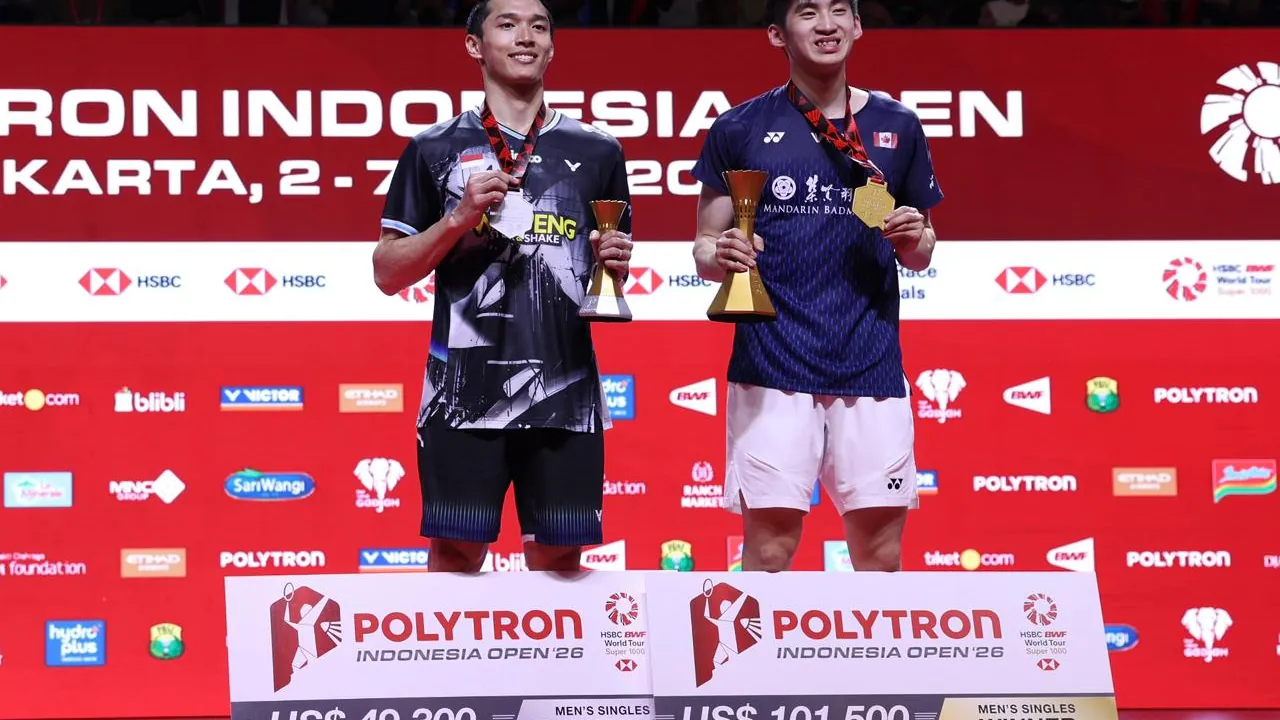
Eleven years after his debut at the Indonesia Open, Jonatan Christie has finally reached the title match. On Sunday at Istora Gelora Bung Karno, the world's top-ranked men's singles player stepped into his first final at his home tournament, a stage that had eluded him even as he collected an Asian Games gold and an All England crown. His opponent is no marquee name but Victor Lai, an unseeded Canadian writing a piece of history of his own. Hanging over the match is a number that has long nagged at Indonesian badminton: 14 years without a home men's singles champion.
A specific drought, not a broad decline
It is worth separating out what is actually at stake, because this title drought is often read too broadly. Indonesian badminton is not in general retreat. In doubles, the host nation's dominance is alive, and this season again produced a finalist in men's doubles. What has dried up is one discipline on one stage: men's singles at the Indonesia Open. The last home winner was Simon Santoso in 2012, when he beat Du Pengyu 21-18, 13-21, 21-11. Since then, no Indonesian man has lifted the trophy at Istora.
That distinction matters because it changes how to read the weight Jonatan carries. The problem is not that the generation after Simon lacks class. Jonatan Christie and Anthony Sinisuka Ginting have both broken into the world's elite, won prestigious titles, and anchored the national team. Yet the Indonesia Open, the most prestigious tournament on their own calendar, has kept slipping away. What is being tested today is not Jonatan's technical ability but his capacity to finish on the stage that drains him most.
Why this final carries history
The Indonesia Open holds Super 1000 status, the top rung of the BWF World Tour, with the largest prize money and ranking points on the calendar. Only a handful of tournaments carry that billing, and Indonesia stages its event before thousands of fans for whom badminton is close to a national identity. It is precisely that mix of prestige and public pressure that has made the absence of a home men's singles champion stand out more sharply year after year.
The weight now rests entirely on Jonatan. His route to the final was not without drama. In Saturday's semifinal, he fell behind before turning the match around to beat Thailand's Panitchaphon Teeraratsakul 16-21, 21-10, 21-12 in 58 minutes. That ability to recover from a deficit showed a composure that will be tested to the limit in the final.
"Getting this far means a lot because I've waited for this moment for a long time. I keep working and searching for the right formula," Jonatan said after sealing his place in the final on Saturday. The words hint at a player long aware that a first home final had eluded him, and that the chance is now real in front of him.
Victor Lai and a widening men's singles map
The figure across the net gives this final a dimension of its own. Victor Lai is more than an obstacle to the home favorite. He is the first Canadian to reach the final of a Super 1000 event, and he has done it on his Indonesia Open debut. In the semifinal, Lai knocked out sixth seed Chou Tien-chen of Taiwan in a three-game marathon, 21-19, 19-21, 21-19.
That run is no fluke, and here lies a message larger than who wins today. Over the past few years, men's singles has grown more evenly spread. Dominance is no longer concentrated among a few traditional powers, and players from countries not usually associated with the sport can now reach the final rounds. If a Canadian finalist can go this far in Jakarta, the task of restoring Indonesian rule in this discipline only gets harder. The competition no longer comes only from China, Japan, or Denmark, but from anywhere.
For the host nation, the fact that the opponent is unseeded carries its own psychological risk. Unseeded players tend to swing more freely, unburdened by expectation, while the home favorite carries the hopes of thousands. It is a familiar pattern that has claimed many victims: home pressure that should be an advantage turns into a burden. The question today is simple but unanswered. Can Jonatan finally flip that logic and turn pressure into fuel?
A mirror of renewal: healthy doubles, thinning singles
Tellingly, on the same day Indonesia also placed a pair in the men's doubles final through Raymond Indra and Nikolaus Joaquin. Setting the two disciplines side by side reveals a contrast rarely discussed openly. While the pool of men's singles reserves thins and a single home title has become a wait of more than a decade, doubles keeps producing young pairs who reach the top level. Raymond and Joaquin are even openly aiming for the world's top ten.
"Our target this year was the top 10, and next week it's official. Now we're switching the target again to seven or eight, as soon as possible," Raymond Indra said of their ranking ambitions. That kind of confidence from a pair only recently on the rise reflects a depth of talent in doubles that men's singles does not currently have.
The men's doubles final has an emotional edge too. Raymond and Joaquin face the Malaysian pair Goh Sze Fei and Nur Izzuddin, the team that beat them at the Indonesia Masters in January 2026 by a clear 19-21, 13-21. "We already had a flashback yesterday and reviewed that first loss. We want to be better than before," Nikolaus Joaquin said. To reach the final, they first won an all-Indonesian duel against Sabar Karyaman Gutama and Moh Reza Pahlevi Isfahani 21-15, 21-18.
"It was an incredible match against Sabar and Reza. The second game was tight at 16-all, but I convinced myself this is a chance that doesn't come twice. Thank God we won," Joaquin said of the close semifinal.
What is at stake beyond the trophy
Beyond the title, today's result will feed into a longer debate about player development. If men's singles fails again at home, pressure on the direction of PBSI, the Indonesian Badminton Association, in this discipline will almost certainly grow. A win, by contrast, would break the "always falling short at home" narrative and offer a morale boost ahead of the next major competition cycle. The burden and the opportunity are equally large.
The trend does suggest doubles will be Indonesia's short-term mainstay, while men's singles needs time to rebuild its second-tier depth. But such projections should be read as a reading of the situation, not a verdict. One tournament will not solve the question of renewal, and one defeat does not automatically mean decline. What is certain is that Istora today is the stage where two different stories about Indonesian badminton run side by side.
In women's singles, the final pits An Se-young of South Korea against the defending world champion, Japan's Akane Yamaguchi, a match that further underlines how Istora this week has become a meeting point for the world's badminton powers.