
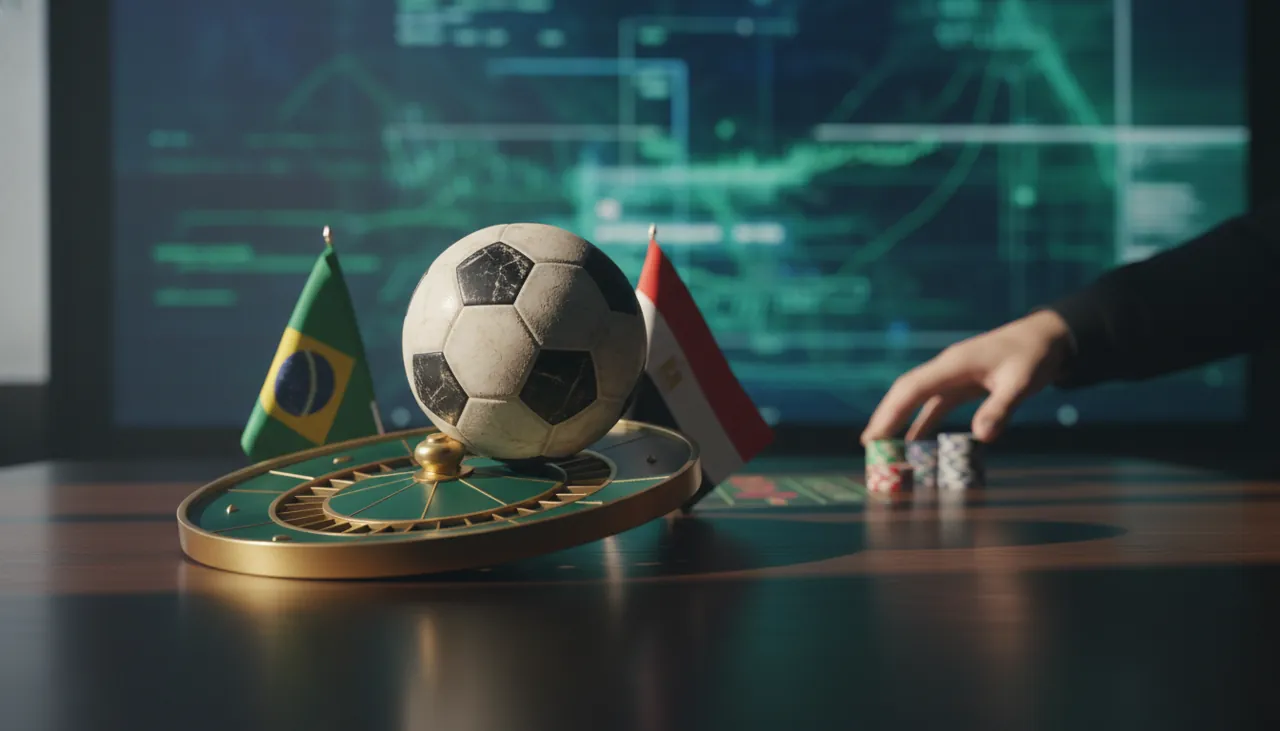
Brazil closed out their 2026 World Cup warm-up schedule with a 2-1 win over Egypt at Huntington Bank Field in Cleveland early Sunday (7/6/2026) Indonesia time. Bruno Guimarães opened the scoring in the eighth minute, Mostafa Ziko levelled three minutes later, and Endrick settled it in the 53rd. But the scoreboard masks a far thornier problem for Carlo Ancelotti. The question is not whether Brazil can score. It is whether the way they score is sturdy enough to hold up under tournament pressure.
A Win That Hides Its Doubts
On the surface, the Seleção's last two results look reassuring. A week before facing Egypt, they thrashed Panama 6-2 at the Maracanã on Monday (1/6), with goals from Vinícius Jr, Casemiro, Rayan, Lucas Paquetá, Igor Thiago and Danilo. The attack was humming, the scorers' list was long, and even Ancelotti's wholesale second-half changes against Egypt still delivered a win.
Yet the Egypt match gave the more honest signal. A side that is far from elite still found a way to beat Brazil's goalkeeper, even with many regulars rested. Conceding to opponents of Egypt's level, in the middle of personnel experiments, is the kind of detail that is easy to wave away in victory but costly against a team like Morocco in the knockout rounds.
The context of Ancelotti's appointment raises the stakes further. He is the first foreign coach to lead Brazil into a World Cup finals, a bold institutional call by the CBF. A five-time world champion whose footballing identity is bound up with expressive attacking play is now run by an Italian known throughout his career for pragmatism and tactical order. That clash of opposites is the heart of the story heading into the tournament.
More Attackers, but Not Necessarily More Goals
This is where a distinction often missing from the "Brazil have everything up front" narrative comes in. The Seleção's problem is not a shortage of attackers. It is that their best stars are less productive in the yellow shirt than at their clubs.
According to Opta data, Vinícius Jr contributes 0.79 goal involvements per game for Real Madrid, but that figure drops to 0.36 with Brazil. Raphinha follows the same pattern: 0.72 at Barcelona, only 0.47 for the Seleção. Piling up attacking talent, then, does not automatically solve anything, because the two main weapons already show a sharp gap between club and country. Adding a third and fourth forward to the pitch may not double the output. It may simply widen the holes elsewhere.
That gap is felt most in midfield. Ancelotti tends to field a 4-2-4, a mirror of his glut of forwards and his thin stock of midfielders. The match data show Brazil launching 25 direct attacks against 30 built from the back, the picture of a team leaning fast and vertical. With only two midfielders supporting four attackers, the old question returns: who keeps the balance when the ball is lost and the opponent breaks?
Ancelotti himself seems aware that the ideal squad is a fiction. "Can I build a perfect squad? Impossible! But I can build a squad with fewer mistakes than the others," the Brazil head coach said, as quoted by Goal.com. The remark is more than modest rhetoric. It concedes that every selection is a trade-off, and that his job is to minimise the damage rather than chase perfection.
Not every line carries a question mark. The centre-back pairing of Marquinhos (PSG) and Gabriel Magalhães (Arsenal) is rated the most settled, a combination fielded together several times and proven solid. Casemiro, who shares the captaincy with Marquinhos, will play his third World Cup, while Manchester United's Matheus Cunha is preparing for his first major tournament. That spine is experienced enough. What remains unproven is whether it can paper over the risk created by the attacking choices in front of it.
Neymar: Bold Bet or Risky Luxury
Ancelotti's most divisive decision is not tactical but a single name: Neymar. The talisman, only recently back from a serious injury and short on competitive minutes, still made the 26-man squad, while a fit João Pedro of Chelsea was left out. For some in Brazil, it reads as an emotional call, choosing aura and reputation over actual fitness.
Ancelotti rejects that reading. "I wasn't pressured by anyone to call up Neymar. I have full autonomy," he insisted. He added that the reasoning was purely technical: "This decision is 100 percent professional. I'll only consider how he performs as a footballer." On the player's condition, he was cautious. "I think the situation is very clear. Neymar has done very good individual work. After the weekend he'll have an MRI, and if everything goes well, he can train with the team next week," he said.
The point worth stressing, and one often lost in the noise of the debate, is that Neymar is not yet confirmed to play. He sat out the Egypt match. His status depends on the MRI result and his fitness progress, with the most optimistic target being the opener against Morocco or the second game against Haiti. Putting a name on the 26-man list is one thing; sending him out when the stakes are high is another. Reading the decision as guaranteed minutes for Neymar misreads what has actually happened, which is a chance that is still conditional.
If Neymar's fitness does not come good in time, the risk is real: Brazil could lose a squad slot to a player who contributes little, while a fit talent who was cut watches from home. If he returns to his best, Ancelotti will look like a coach brave enough to wait for a special player. The line between courage and a risky luxury is thin here, and only results on the pitch will decide which way the decision is remembered.
Why This Matters to Indonesian Viewers
Brazil are among the most beloved national teams for fans in Indonesia, and their matches will be broadcast free, including on TVRI, during the 2026 World Cup. The consequence is familiar: the time difference with the Americas will force fans back home to stay up late. The opener against Morocco is set for June 14 at 05.00 WIB at MetLife Stadium, followed by Haiti on June 20 at 07.30 WIB in Philadelphia, and Scotland on June 25 at 05.00 WIB in Miami Gardens.
But there is a more interesting layer than the late nights. Because the broadcasts are free, Brazil are one of the few elite teams Indonesian fans watch regularly, game by game. That puts Ancelotti's experiment, a foreign coach managing a giant with a strong tradition, in full view on public screens at home, not just as snippets of final results. Indonesian viewers will not only learn whether Brazil won or lost; they will see whether the all-out attacking bet works or breaks under pressure, and whether the Neymar gamble pays off or turns into a burden.
The real test arrives sooner than many expect. Morocco, 2022 World Cup semifinalists and sharp in transition, target exactly the weak point feared in Brazil's 4-2-4. At 05.00 WIB on June 14, before most Indonesian viewers have sipped their first coffee, they may already see an early answer to the Seleção's biggest question. Not whether Brazil can attack, which was never in doubt, but whether Ancelotti's team is balanced enough to hold firm when the opponent attacks back.
What to watch over the next two weeks: the result of Neymar's MRI and his fitness, whether Ancelotti sticks with the 4-2-4 or adds a midfielder for balance, and whether Vinícius and Raphinha can get close to their club output in the yellow shirt. Those three variables, more than any friendly scoreline, will decide whether Brazil are truly ready to end a World Cup title drought that stretches back to 2002.